

The Nkanu people of Nigeria and the Nkanu people of the Congo (Democratic Republic of the Congo/DRC) are two completely different ethnic groups with distinct cultures, locations, and histories, sharing only a similar name.
The Nkanu people of Nigeria are a subgroup of the Igbo people, primarily found in Enugu State, Nigeria. They have a distinct cultural identity within the broader Igbo ethnic group.
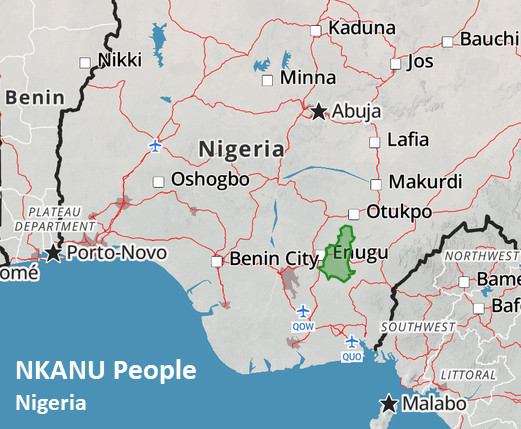
Nkanu people live contigually within the Enugu East Senatorial zone of the present-day Enugu Sate of south-east Nigeria. They are predominantly farmers. The area lie approximately between latitude 60 30’ North and longitude 70 30’ East, and stands on an estimated excavation of about 763 feet above sea level. According to sources from the defunct State Ministry of Works, Land and Transport, Nkanu clan occupies an area of about 1602. 22 square kilometres.
Nkanu land is divided into two main areas:
Both are local government areas in Enugu State. Major towns include places like Agbani (a prominent cultural and administrative center).
Nkanu land shares border in the East with Ohaozara and Ivo LGAs in Ebonyi State; on the West with Udi LGA, in the North with Nkalagu (Ebonyi) and Isi-Uzo LGA, and in the South with Aninri and Awgu LGAs.
Populationat present it is presumed to be nearing almost 2 million.
While they share many customs with other Igbo groups, the Nkanu people maintain unique traditions, oral histories, and social structures that set them apart. What sets the Nkanu people apart within Igboland includes:
The Nkanu people speak a dialect of the Igbo language, with slight variations that distinguish them from other Igbo subgroups
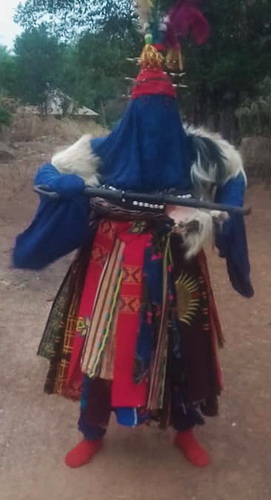
Masquerades (Mmanwu) are central to Nkanu spirituality and social order. They:
As has been observed earlier, the various masquerades and festivals found in the area reflect the cultural diversities of the Nkanu people. Some of these cultural identities are common; while others are community-specific, or peculiar to a particular community. Igede, Ikpa, Okanga, Ubo, Ebe, and so on, usually displayed during festive and burial ceremonies are most common within the area. While Omaba and Ekpe masquerades as well as Achikwu (Maa Enyashi – nocturnal masquerade), forbidden to non-initiates and women are renowned masquerades of the people. Edene war dance music is peculiar to only the Obeagu (Awkunanaw) people in the whole of Nkanu land.
Aju festival, which heralds the New Year, is widely celebrated in the area. Ani Oha (an equivalent of the Christmas), associated with the soul day (Igo Iyi) is celebrated in commemoration of the departed soul of either the grandfather and/or grandmother.
Noteworthy of mention is the Ugwu Uzu deity in Obeagu (Awkunanaw). It was said that in the olden days, blacksmiths from all over Igbo land and beyond converged at Obeagu to celebrate and pay homage to this deity of blacksmithry. Blacksmiths from as far as Awka, Nkwerre, Agulu, Agbor, and even Igalla come to this festival. They not only fraternize with one another, but brainstorm and rub minds on the improvement of their trade. Various metal products are on display. After days of merrymaking, feasting and toasts they return to their different abodes. Yet, Obeagu people are not traditional blacksmiths, nor are the Nkanu people in general. Nevertheless, the conviviality this festival generates, can only be likened to what happens in modern-day trade fairs.
It is, however, lamentable and sad to observe the degree of westernization the people had embraced, had eroded the potency of some of these cultural identities of the Nkanu people. If serious care is not taken to preserve them, they might as well be on their way to extinction.


Important festivals often revolve around agriculture:
Traditional marriage involves several stages:
Marriage is seen as a union between families, not just individuals.
The Nkanu people trace their roots to the larger Igbo people, with oral traditions suggesting migration from older Igbo heartlands. Like many Igbo subgroups, their early history is preserved mainly through storytelling rather than written records.
During the colonial period under the British Empire, Nkanu society—like much of Igboland—experienced administrative restructuring, introduction of Christianity, and new economic systems. These changes reshaped traditional governance and social life
Traditionally agrarian, the Nkanu people farm crops such as yam, cassava, and maize. Trade and small-scale businesses are also common.
Nkanu communities traditionally operate a decentralized system, typical of Igbo societies:
However, modern times have seen the rise of recognized traditional rulers (Igwe/Chiefs), blending old and new systems.
Before Christianity, Nkanu spirituality followed core Igbo beliefs similar to the wider Igbo people:
Today, many Nkanu people are Christian, but:
Nkanu is not a single town—it’s a cluster of communities, especially in Enugu State. The Major Nkanu Towns are:
In Nkanu communities (especially around Agbani and nearby towns), daily life blends tradition with modern Nigerian life:
Even for those living in cities, returning home for festivals and family events remains very important.
Nkanu food is part of the broader Igbo cuisine, but with local preferences:
Palm oil is widely used, and meals are often communal.
Names in Nkanu carry deep meaning, reflecting spirituality, circumstances of birth, or family history.
Examples:
Names often:
Naming ceremonies are family-centered and culturally significant.
Nkanu society is highly lineage-based:
Key features:
Traditional attire appears mostly during ceremonies:
Marriage is one of the most important institutions among the Nkanu people and follows a structured, family-centered process:
This step makes the relationship official between both families.
Marriage is seen as a union of families, so background matters.
Sources: