

The Nkanu people of Nigeria and the Nkanu people of the Congo (Democratic Republic of the Congo/DRC) are two completely different ethnic groups with distinct cultures, locations, and histories, sharing only a similar name.
The Nkanu people (also known as Bakanu, Bankanu, or N'Kanu) are an ethnic group of approximately 5,000 to 10,000 individuals living on the border region between the southwestern Democratic Republic of the Congo (DRC) and northern Angola. They are considered part of the eastern Kongo cultural group, residing between the Yaka and Kongo peoples.
The language of Nkanu is the Kinkanu (central Bantu)
Neighbouring Peoples: Yaka, Suku, Kongo, Lula.
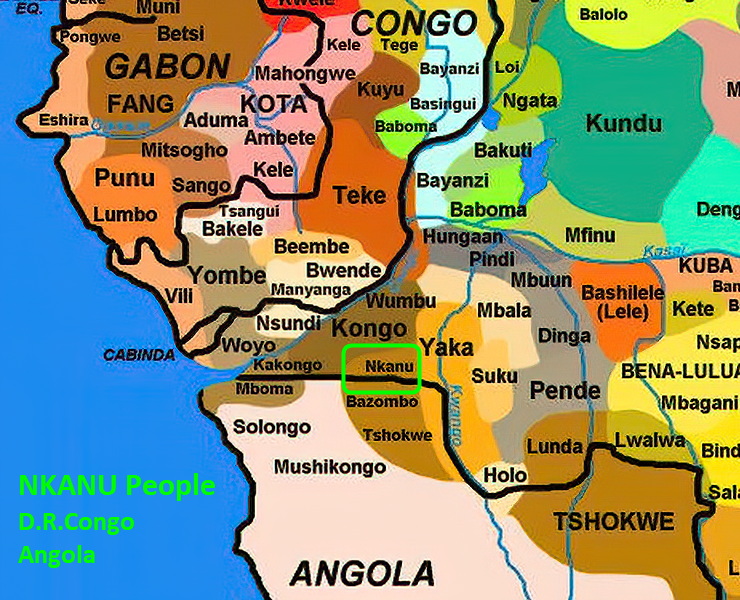
The Nkanu area, specifically in the lower Congo region, was historically affected by both the Portuguese slave trade and the influence of the Kongo Kingdom. The area they occupy is rich in historical significance and is bordered by the Kwango River to the east.
Among Nkanu, men contribute to the local economy largely through hunting. They may hunt either individually or in groups, and most often use bow and arrow, or old rifles. The women contribute primarily through cultivation of cassava, sweet potatoes, beans and peanuts. They further supplement the diet through the gathering of wild fruits and berries and occasional fishing in the nearby rivers. Manioc is the main staple throughout the region, but maize is also very important. Intergroup trade with neighbours in the region play a critical role in Nkanu economics.
Like most of the peoples living in this region, Nkanu peoples traditionally observed matria lineal descent, inheritance rites, succession, and residence patterns. Although in recent years there has been a tendency for some sons to reside in their own villages after marriage, succession and inheritance still observes local patterns. In most cases, however, when a man and a woman are married they move to the village of the bride. Many times the bride's father is the brother of the groom's father.
In effect, the groom is marrying his maternal cousin and living in the compound of his maternal uncle. In this way power resides within the maternal line. This arrangement results in a relatively high value being placed on daughters, who in most cases bring in a considerable bride price for her family. It does not necessarily increase her power, however, as she is still at the mercy of the men in her life.
Their traditional religion includes belief in a creator God in the sky, though religious practices focus more on honoring ancestors and elders.
There is creator god who inhabits the sky and is responsible for life, death and all unanswerable questions. There are no religious practices which actively pay homage to this God. Instead, religious celebrations focus on honouring the elders and ancestors. The death of an elder is cause for a public ceremony performed by other elders. Ancestors may be honoured by recognizing and practicing the traditional ways and through offerings and gifts. The offering place is usually a clearing in the forest, removed from the everyday interactions of village life.
Offerings may otherwise be made at the grave site of the ancestors.
The Nkanu organize initiation rites for boys and young men. These rites, called nkanda or mukanda, take place over several months at the age of puberty. A dominant theme of the ritual is the symbolic death and rebirth of the individual who begins nkanda as a child and re-enters society at the conclusion of the rite as an adult. Initiates live in a specially constructed enclosure situated outside the community. Physical and psychological changes take place as the initiates are circumcised, acquire specialized knowledge, and learn the skills necessary for adult life.
Sculptors who are also ritual specialists well versed in the esoteric knowledge and symbolic visual language of nkanda arts produce the works. During initiation, the youths observe the creation of masks, figures, and carved panels, most of which are destined for public display at the conclusion of the initiation cycle. Thus, by observation--and perhaps by helping carvers in small tasks--Nkanu initiates learn about the forms, designs, and meanings of initiation arts. An elaborate celebration at the conclusion of nkanda reintroduces the initiates to the community as adults. During this period of intense artistic activity, specialized wood sculptors create wall panels, carved in high relief, with images of men, women, and animals.
The Nkanu tribe live in an area of central Africa that is rich with historical narratives and events. They are situated between Kongo and Yaka peoples, both powerful empires during the last couple of centuries. As such, their own history is best understood when viewed within the context of the whole region. In 1482 the Portuguese arrived on the coast, beginning diplomatic relations with Kongo royalty which included sending Kongo nobles to visit the royal assemblage in Portugal in 1485.
The relationship established between these two empires brought both Christianity and slaving into the region. Nkanu peoples were undoubtedly affected by both of these influences. Nkanu share many cultural and linguistic similarities with their Yaka and Lula neighbours, indicating probable historical connections between them.
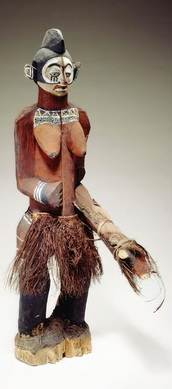
Nkanu art is similar to that of the Yaka and Lula neighbors, known for carved wooden masks and anthropomorphic sculptures used during ceremonies and initiation rituals. They carve wooden masks that are used for ceremonial purposes and anthropomorphic wooden sculptures.
Although the types of artifacts produced by the Nkanu were influenced by the Kongo and Yaka, they achieved a distinctive style through the use of polychrome pigments. Nkanu statues are characterized by a circular line around the eyes, while their large initiation masks feature bulging eyes and prominent cheekbones.
Men's initiation rituals of the Nkanu are similar to those practiced by other peoples in eastern Angola, the southwestern Democratic Republic of the Congo, and western Zambia. Nkanda (known as mukanda by other peoples in the area) is accompanied by an artistic complex that includes a variety of sculpture, masquerades of fiber and wood, elaborate costuming, special dances, and musical accompaniment. Nevertheless, nkanda initiation varies across this region in form, aesthetic content, and frequency owing to historical circumstances and cultural preferences.




Sources: