
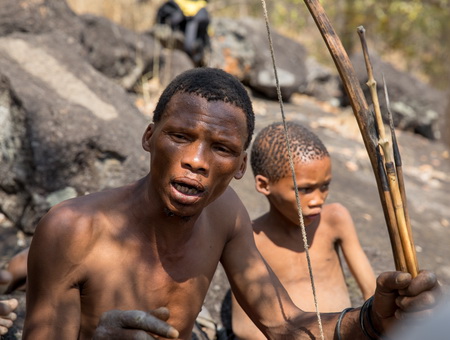
The Khoisan, or Khoisanid are terms that define a significant African population group in the cultural, ethnic, linguistic, and genetic sense; they come from the union of Khoi (Khoikhoi) and San, the main groups that speak one of the Khoisan languages, characterized by incorporating clicking or clicking sounds.
Culturally, they are divided into:
Khoisan are also called populations with interbreeding between Khoi and San peoples, for example in some populations on the coasts of South Africa, Botswana, and Angola.
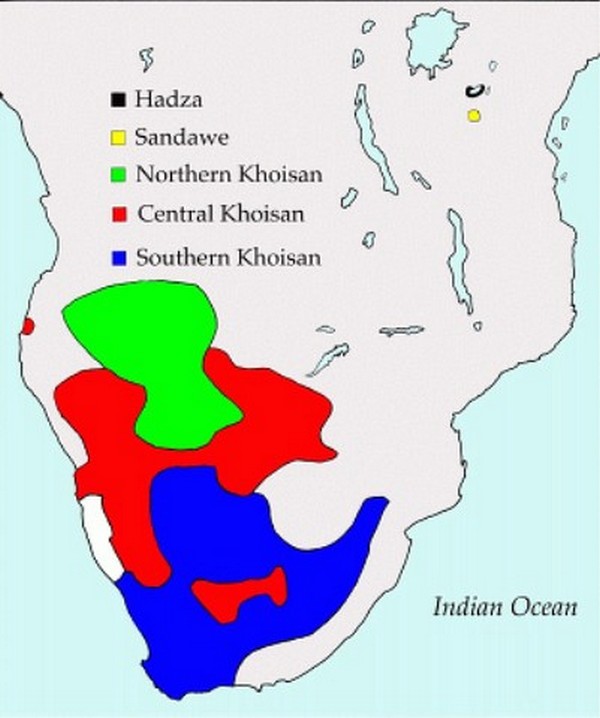
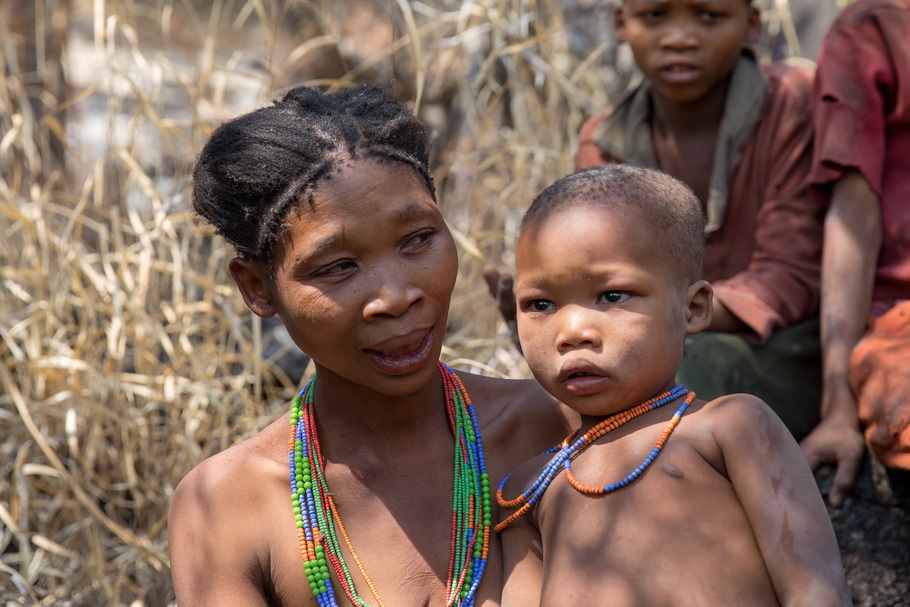
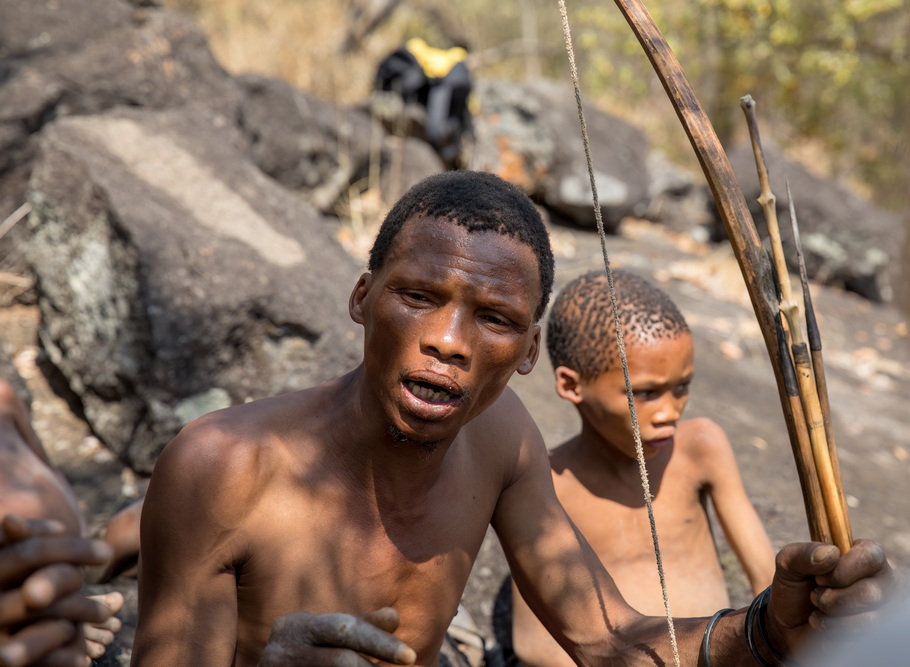
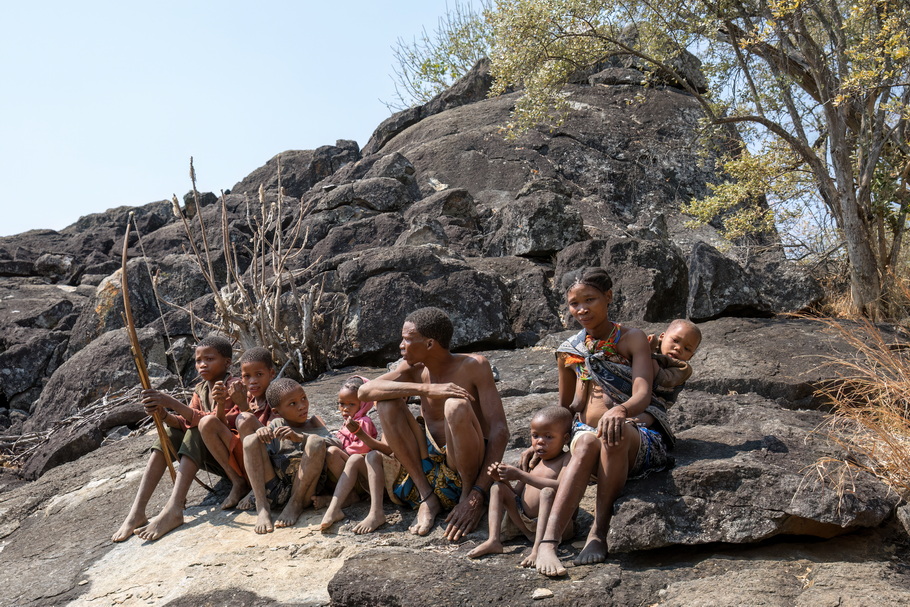
The Khoisan are one of the two major groups into which sub-Saharan Africa is sometimes divided, in contrast to the other peoples who are predominantly Niger-Congolese (such as the Bantu). They share significant linguistic and physical differences, such as less dark skin, very short hair arranged in "pimples," a flatter nose, somewhat Mongoloid eyes, a graceful chin, and shorter stature. However, the most important differences they have with the population, not only of Africa but of the rest of the world, are at the genetic level. as stated by Sarah Tishkoff, an African population geneticist at the University of Pennsylvania, who suggests that the Khoisan are the human lineage with the oldest DNA, due to a likely genetic rift in Africa that occurred due to arid conditions that led to a split between humans from the east of the African continent and those from the south, as it is suggested that East Africa suffered a series of severe droughts between 135,000 and 90,000 years ago that nearly caused the extinction of the human species. This would be the longest period that two modern human populations have been isolated from each other.
The Khoisan are considered heirs of the Sango culture due to the similarity of the skeletal remains found. This culture developed in Central Africa more than 130,000 years ago.
They expanded and occupied a vast territory, the entire southern Africa, and 100,000 years ago they reached the southern tip of the continent, being the first populations of Homo sapiens to occupy southern Africa. There, on the coast, they ate shellfish and slept on woven grass mats.
There are rock paintings in the Apollo XI Cave in Namibia dating back 25,000 years, and paintings and rock carvings have been abundant for 10,000 years, even dating back to the time of the Bantu invasion.
Around 2,600 years ago, the Khoi people developed pastoralism.
From 2,000 years ago until approximately the 6th century, the Khoi were gradually displaced by mainly Bantu peoples arriving from the northwest and were eventually reduced to areas of southwest Africa, primarily around the Kalahari Desert. These newly arrived peoples had reached the Neolithic period, so they had a tradition of agriculture and knowledge of metals. They arrived in large numbers and often interacted in various ways with the Khoisan.
Consonant clicks or clicks are characteristic of languages of the Khoisan family, some of which have up to 80 different types; !Xu has 141 sounds. Specifically, 70 percent of words begin with a click, which are divided into ingressive when air enters the mouth and egressive when it leaves the mouth. There are bilabial clicks, for example, an ingressive one that sounds like a kiss, and others that are made with the tongue, dental, alveolar, lateral, and palatal. They are represented in writing by signs such as ≠, !, or //. It is believed that some Bantu languages use clicks due to the influence of Khoisan languages.
Linking the "mitochondrial Eve" and her counterpart, the "chromosomal Adam," one branch of the genetic path headed toward North Africa; this would eventually become the genetic foundation of all humanity. The other branch headed toward the south of the continent, developing its evolution in that small portion of the planet. At some point in this second branch, the Khoisan appeared.
Genetic analysis of the Khoisan primarily shows the matrilineal (mtDNA) L0 haplogroup and the patrilineal (Y-DNA) A haplogroup.

Sources: