

The Bambara (Bambara: Bamana or Banmana) are a Mandé ethnic group native to much of West Africa, primarily southern Mali, Guinea, Burkina Faso and Senegal. Today they make up the largest Mandé ethnic group in Mali, with 80% of the population speaking the Bambara language, regardless of ethnicity.

Bamana, Banmana, Bamanan (pl. Bamananw)
The term "Bambara" has been widely used by European writers, Arabs and some Africans alike to refer to a large group of Mande speaking and ethnically undifferentiated non-Muslim people inhabiting a vast expanse of land along both sides of the Niger River in West Africa (Monteil, 1924). According to one French scholar, however, the Bambara themselves have a rather clear idea of their early history and ethnic identity. They call themselves "Bamanan" (pl. Bamananw) which translates as "rejection of a master" (Dieterlen, 1951:12). The Bambara use this designation to reinforce shared traditions which recount how their ancestors escaped enslavement by Malinke conquerors in the 13th century by leaving their original homeland Toron (in the present Côte d'Ivoire) for settlement along the middle valley of Niger in Mali. As a vernacular identity, Bambara doesn't include other Mande speaking ethnic groups which continued to be subjects of the old Malinke empire. Historically, the Bambara have been the largest and most dominant ethnic group in Mali. There are also a small group of Bambara people living in the neighboring Burkina Faso, Côte d'Ivoire and Mauritania.
Bambara people speak Bambara, also known as Bamana, and Bamanankan which is one of the Manding languages. Bamana is also Mali's national language. It is widely spoken throughout the country by as much as 80% of the population (Gordon, 2005). It is a mande language that belong to the larger Niger-Congo family.

Malian artists such as Oumou Sangaré, Rokia Traoré, Ali Farka Touré, Salif Keita, Habib Koité, and the blind couple Amadou & Mariam often sing in Bambara. Aïda of the band Métisse often sings in Dioula, as does Mory Kante, born in Guinea to a Malian mother; his most famous song to date is "Yeke Yeke" (Alpha Blondy). Lyrics in Bambara occur on Stevie Wonder's soundtrack Journey through the Secret Life of Plants. Tiken Jah Fakoly (reggae) often sings in Dioula and French.
Additionally, in 2010, Spanish rock group Dover released their 7th studio album I Ka Kené with the majority of lyrics in the language.
According to a widely documented local tradition, the Bambara are not native to their present homeland. Instead, their ancestors originally lived in a region called Toron which is situated in Côte d'Ivoire along the upper catchments of the Niger River. From Toron, the Bambara moved in a northeasterly direction and then spread out towards the middle valley of the Niger where they developed a powerful empire based in Ségou during the 1700s (Monteil, 1924: 15-16). This empire started to expand under the leadership of Kaladian Coulibaly who successfully subdued several rival chiefs until his death in 1680.

The empire expanded under Kaladian Coulibaly's grandson Mamary Coulibaly who established a strong personal army largely recruited from a traditional youth organization called tón. Mamary Coulibaly died in 1755 after leading successful assaults against neighboring Fulani, Soninke and Mossi peoples. He was survived by two sons Dinkoro Coulibaly and Ali Coulibaly but they were unable to hold the empire together. In 1766, a former slave called Ngolo Diarra came to power through a coup and established control over the empire.

His descendants successively ruled and expanded the empire until it was finally conquered by the Tukolor-based Jihadist army of El Hadji Umar Tall on March 10, 1861 (Paques, 1954). The Tukolor rule in its turn came to an end in 1890 when the French occupied Mali. Following Mali's independence in 1960, the Bambara have been administered mostly through their own village chiefs who function as local agents of the state.

Generally, Bamanankan give first names to their children according to the order of birth. The first son is Nci, the second is Ngolo, and the third is Nzanke. It is usual also that the first son bears the name of the father. But it is clear that since the arrival of Islam, Bamanankan converts, more and more numerous, have taken Muslim first names. In doing so, their children and grandchildren no longer carry traditional names because they are given the first name of the Muslim grandfather even when the parents themselves are not Muslims. It is even common to meet children born in Christian families have Muslim names because of the person who is honored by giving his name to the child.
In Mali, some ethnic groups wear scarification to distinguish themselves from others. This tendency tends to be lost and we meet less and less. However, the scarifications do not always refer to ethnicity, tribe, clan, or name. They can also the birth place of the individual.
Although most Bamana today adhere to Islam, many still practise the traditional rituals, especially in honoring ancestors. This form of syncretic Islam remains rare, even allowing for conversions that in many cases happened in the mid to late 19th century. This recent history, though, contributes to the richness and fame (in the West) of Bamana ritual arts.

The Bambara live in nucleated villages which are often located near a watercourse where wells could be dug. Each village is divided into several wards consisting of several households. Most villagers belong to one lineage or extended family. Some villages may include new Bambara settlers and Fulani herders who came to live there for the time being with the permission of the village chief. Each village has a sacred woodlot or a dwelling place for protective spirits where religious ceremonies and initiation rites take place. The center of the village is marked by a cleared space where elders hold their councils. Before the French conquest, Bambara villages were fortified by a triple enclosure of clay blocks (Monteil, 1924). The first wall enclosed the entire village and surrounding gardens, while the second circled the interior of the village. The third circled the chief's house for protection and as a status marker. Most of the houses are round huts with thatched roof and woven bamboo walls. There are also some rectangular or square huts made of dried bricks (Toulmin, 1992).
Traditionally, Mandé society is hierarchal or caste-based, with nobility and vassals. Bamana political order created a small free nobility, set in the midst of endogamous caste and ethnic variation. Both castes and ethnic groups performed vocational roles in the Bamana state, and this differentiation increased with time. For instance, the Maraka merchants developed towns focused first on desert side trade, and latter on large-scale agricultural production using slaves captured by the state. The Jula specialised in long-distance trade, as did Fula communities within the state, who added this to cattle herding. The Bozo ethnicity were created largely out of war captives, and turned by the state to fishing and ferrying communities.
In addition to this, the Bamana maintained internal castes, like other Mandé peoples, with Griot historian/praise-singers, priests, metalworkers, and other specialist vocations remaining endogamous and living in designated areas. Formerly, like most other African societies, they also held slaves ("Jonw"/"Jong(o)"), often war prisoners from lands surrounding their territory. With time, and the collapse of the Bamana state, these caste differences have eroded, though vocations have strong family and ethnic correlations.

The Bamana have continued in many places their tradition of caste and age group inauguration societies, known as Ton. While this is common to most Mandé societies, the Ton tradition is especially strong in Bamana history. Tons can be by sex (initiation rites for young men and women), age (the earlier young men's Soli Ton living separately from the community and providing farm labor prior to taking wives), or vocation (the farming Chi Wara Ton or the hunters Donzo Ton). While these societies continue as ways of socialising and passing on traditions, their power and importance faded in the 20th century.
The Bamana people adapted many artistic traditions. Artworks were created both for religious use and to define cultural and religious difference. Bamana artistic traditions include pottery, sculpture, weaving, iron figures, and masks. While the tourist and art market is the main destination of modern Bamana artworks, most artistic traditions had been part of sacred vocations, created as a display of religious beliefs and used in ritual.
Bamana forms of art include the n’tomo mask and the Tyi Warra. The n’tomo mask was used by dancers at male initiation ceremonies. The Tyi Warra (or ciwara) headdress was used at harvest time by young men chosen from the farmers association. Other Bamana statues include fertility statues, meant to be kept with the wife at all times to ensure fertility, and statues created for vocational groups such as hunters and farmers, often used as offering places by other groups after prosperous farming seasons or successful hunting parties.

Art hold special place in Bambara culture. To them every piece of art holds a significance in either a religious, societal, or technical way.
The Bambara use a wide variety of artistic objects (such as masks, sculptures, ceramics and paintings), music and literature. Each of these arts has clearly defined cultural, symbolic, and social functions relating to rituals, ceremonials and other life situations. Some of the artistic objects are produced by specialized caste groups. Masks and sculptures are, for example, done by male blacksmiths while women of the caste generally make pottery. Griots (praise singers) sing and play drums, harps and other instruments during divination, sacrificial rituals, magical rites and holidays. Painted murals and decorations are found on sanctuary walls, peoples' houses, calabash spoons and girls' hands. Religious drawings are made by priests, while other signs and decorations may be done by ordinary villagers (Paques, 1954).
Despite an early tradition of bronze and terracotta working in the neighbourhood, their creative art today is predominantly in wood.
Wood carvers belong to the caste of the blacksmiths. They make tools for agriculture as well as ritual objects. They enjoy a special position in the community, and do not intermarry with the rest of the tribe.
Bamana religious life and social structure is traditionally based upon fraternal groups or societies which regulate agricultural work, judge disputes and provide protection against evil spirits and sickness. They each have their own initiation rites and rituals, usually relating to some aspect of fertility. Bamana craftsmen fashion masks and figures for the observance of these societies' rituals.
There are at least five principle societies in Bamana culture. Each has its own type of mask, the style and symbolism of which would be understood by initiates. Characteristic of Bamana masks is a combination of human faces, animal horns and bird feathers, covered with a coating of riverine mud and thus fusing the elements of water, air and earth. The Bamana are well known for their antelope masks which represent the fabulous being, half man half animal, who taught them how to cultivate the earth.
The existence of standing male figures among the Bamana is well-documented, Those that are known are linked to annual ceremonies of the ""Guan"" Society, and they are quite rare. This seated personage is known as a Jomooni or Gwandusu among the Bamana, an important visual component of the Jo initiation society for young boys (and girls) called masiriw literally the visual ornaments of Jow.
Located primarily among the southern Bamana, Jo initiation takes place over a span of years in which the young initiates undergo training and instructions leading to their admission to society as adults instructed in the secrets of Bamana religion and philosophy. This male figure holds weapons in hands and wears a carved hat with protective amulets or charms and animal horns compared to the real hat worn by digintaries among the Bamana. The long standing presence of Islam among the Bamana is reflected in the magical and protective amulets that in many instances contain a verse from the Koran that adorn the hat blending Bamana local animist religion and Islam.
The Bambara are traditionally subsistence farmers. Millet is their main crop. Their next largest crops are sorghum and groundnuts. These three crops are their main agricultural outputs. In private gardens maize, cassava, tobacco, and many other vegetables are grown.
They also raise cattle, horses, goats, sheep and chickens. Bambara farmers are especially known for the bond friendship they long maintained with the neighboring Fulani herders. In this arrangement, Fulani herders are trusted to herd the Bambara livestock. In recompense for the service, each Fulani receives a herding fee (often in the form of millet or cash) and a variety of favors from the herd owning Bambara.
The Bambara also hunt animals such as boar, ostrich, guinea fowl, and antelope for meat and skins as well as collect honey from wild bees. However, this is not their only source of meat and skins. To help with the farming the Bambara own cattle, goats, horses, sheep, and chickens. Although the herding of these animals is actually tended to by a neighboring culture called the Fulani in exchange for millet, sorghum, and groundnuts.
Many Bambara farmers also augment their income by participating in a variety of non-agricultural activities including trade, wage labor, small-scale craft production, charcoal making, hunting and collection of wild resources (Toulmin, 1992). Seasonal migration and market gardening (i.e., growing vegetables and fruits for sell) are especially recognized by many Bambara as important income generating strategies (Wooten, 2003).

Both men and women take part in farming, but very clear division of labor by gender persists (Wooten, 2003:5). Men work collectively to produce food crops such as millet, sorghum and cowpeas. Married women work individually in small fields to produce sauce crops (mainly okra and peanuts) that complete the daily meals they cook. Unmarried girls devote most of their time to household chorus such as fetching water, child care, and house cleaning, while young boys look after livestock.
“Among the Bamana, women, in addition to taking care of many household chores, work most of their lives in the collective fields of their husband's extended family. Once women reach menopause they retire from work in the collective fields and often redirect their efforts in the cultivation of their own fields.
Women are also very active in trade activities. Postmenopausal women, as in many other parts in Africa, are freer to engage more extensively in trade activities than are women of childbearing [sic] age.
However, women sell mainly food items, both raw and processed, and a few manufactured goods (e.g. cloth), while men engage more often in the sale of manufactured goods. In other words, women's access to market participation tends to be limited to a series of economic activities which are scarcely lucrative, or at least less so if compared to the business in which men engage.”
The Bambara household (gwa, literally a hearth) is the basic unit of production and consumption, farming a communal field and eating from a single granary. Bambara households tend to be much larger than those found in many other parts of Africa where extended households have been under increasing pressure to dissolve into smaller components. According to a 1981 study conducted in the Bambara village of Kala, for example, the average household consisted of more than 18 members (Toulmin, 1992:23). Household heads ensure the continuity of these large units by allowing ambitious members to obtain personal income through part time engagements in wage labor, market gardening, petty trading and crafts work. Household members usually keep their personal income for their own use, while household heads cover all other expenses relating to food, clothing, tax payments, and wedding expenses.
The village chief owns all the land on behalf of individuals belonging to the same patrilineal lineage (fa). The chief allocates the land in two ways which recognize the need to balance between group and individual rights. Each household head (dutigi) receives "big field" to be operated as a common property (foroba) by all household members. Junior men, who live under the authority of a particular household head as his younger brothers, sons, nephews, grandsons, grandnephews, etc, receive "personal fields" (jonforow). Likewise, women who are wives in the household receive "women's fields" (musoforow). Women and junior men cultivate their personal plots, usually for growing commercial vegetables and fruits or just as pulse fields, on their own time after work on the household farm. Through time, however, married women retire from the household farm and fully concentrate on cultivating their personal fields (Becker, 1996:6-7). Land is generally abundant and both men and women receive as much fields as they can work (Toulmin, 1992).

Bamana share many aspects of broader Mandé social structure. Society is patrilineal and patriarchal, though virtually no women wear a veil. Mandé culture is known for its strong fraternal orders and sororities (Ton) and the history of the Bambara Empire strengthened and preserved these orders. The first state was born as a refashioning of hunting and youth Tons into a warrior caste. As conquests of their neighbors were successful, the state created the Jonton (Jon = slave/kjell-slave), or slave warrior caste, replenished by warriors captured in battle. While slaves were excluded from inheritance, the Jonton leaders forged a strong corporate identity. Their raids fed the Segu economy with goods and slaves for trade, and bonded agricultural laborers who were resettled by the state.
The Bambara live in closely organized village communities where residents maintain wide ranging, and often overlapping, duties and expectations to one another as lineage members, age mates, neighbors and patron-clients. Each village has a chief, usually the senior noble man from the founding lineage, who exercises extensive moral and legal authority relating to land redistribution, inter-household relations, religion and ceremonials. Young men and women of each village are also linked through membership in age-based associations. All men circumcised at the same time form a single age-group. Within the age group each member has a special relationship of equality, trust, and mutual help with the others regardless of lineage status or household wealth. Likewise, women who marry in the same year form a mutual help association to support each other in cotton-spinning and pounding millet. In each village, young men belonging to different age-sets form a village-wide youth association (tón). The tón may also function as a work-group that is hired by well-off household heads. The group uses its earnings to cover expenses for a three-day annual festival. At the annual festival, which takes place prior to the cultivation season, porridge and meat is provided for the whole village.
The village chief uses his culturally and constitutionally recognized authority to adjudicate disputes involving individuals and households. In doing so, the chief is often assisted by a council of elders composed of the heads of wards and extended families.
Traditional Bambara society is hierarchically divided into three caste-like social groups. These are the nobles (horon) who fought and farmed, the slaves (jon) who worked for their masters, and the occupational castes (nyamakala) including blacksmith, pottery makers, tanners, carpenters, and griots who sang the nobles' praises. Following Mali's independence in 1960, the government enacted a law providing free access to land and water resources to all villagers regardless of their social backgrounds. But the actual implementation of this legislation by local officials has continued to be informed by traditionally political cultural concepts relating to the chief's powers over villagers and resources (Toulmin, 1992).
The Bambara people trace their heritage through patilineal decent. Patrilocal extended families act as the political structure in Bambara culture. These extended family groups can comprise between 100-1000 members. Young men’s position in their initiation groups plays a significant role in their position within the village in the future.
For the most part, each extended family group makes up its own village. These villages consist of many different households, or gwa. Members of each household work collectively to provide for everyone who lives there. Homes within the village are usually bigger than those in other African societies, often comprising of up to 60 or more family members.
Each village or extended family is known by its symbol, usually an animal. There is a great deal of loyalty among villages of the Bambara. The eldest male in the family is respected as the village chief. When a chief passes away, that authority is passed down to the oldest living male.

The kinship terminology used by the Bambara is indicative of their patrilocal society. Bambara use different words to classify their parallel and cross cousins.
The same word used for siblings also applies to paternal cousins, but not for cousins on the maternal side. Similarly, people call their nieces and nephews on the paternal side “child,” however they do not refer to their maternal nieces and nephews in this way.
Household authority generally passes to the eldest living male who then becomes responsible for the collective household belongings including land, tools and grain stores. Mothers' fields are inherited either by sons or by the sons of co-wives if the former already had enough land to cultivate. With increasing expansion of commodity production, some junior men have sought fission so that they will be a dutigi (“household head”) by their own right using privately earned income (Becker, 1996:4).
Marriage is considered a very important 'investment'; through which legitimate offspring that would ensure the future households and lineages are obtained (Toulmin, 1992:229). Household heads are responsible for arranging marriage for all male members of their household, according to seniority, by finding the right girl, paying required bride-price and by organizing weddings. Individuals do not marry within their own lineage. Women keep their lineage name when they marry. Lineages with similar status usually maintain long established wife exchange relationships. Polygyny and widow inheritance are very common.
Bambara females are usually engaged between ages of four and ten. It is very unusual for girls between the ages of twelve to sixteen to still be unsure of who they are going to marry. Rather than focusing on looks, Bambara males look for hard-working women, who cook well and are productive.
High marriage costs are viewed as an investment. Marriage is a means for having children, which in turn will increase the work force and reinforce the family name. Bambara women have an average of eight children during their lifetime. The majority of women (including the elderly) are married, as a man’s status increases by having a wife.
The male “household head” finds suitable partners and arranges the marriages for all the males within the household. This includes paying the bride-price as well as arranging the wedding. Bambara culture does not permit people to marry within their own lineage. Although Bambara is patrilocal, women do keep their original lineage name after they marry. Polygamy is common among the Bambara. Additionally, it is very rare for widowed women to remain alone. After their husband passes away, she is usually inherited by another male close in the family to her husband.

In Bambara society, women are seen just usually wear a rag or loincloth around their hips, with their breasts exposed. This constant exposure, the Bambara believe, desensitize men from desiring women, as they are always around nearly naked women.
Also, women are used to being seen as objects to men, being often harassed and bossed around by men. Men are often seen chatting about topics such as sex and other vile topics that are considered taboo for women to discuss. Men further separate women by at one point in the night, isolating all young girls to a communal living space, where an older women watches over them to make sure no boys are coming for them for companionship during the night.
Men and women also have secret societies, broken up by gender. Each society for women is organized by age as well as how far they are in their initiation process. Males, on the other hand, have brotherhoods. Both of these type of groups are completely off limits to non-members and cannot be entered by the other gender.
At birth, the baby is washed with millet beer. The patriarch of the clan (the oldest living male member) shakes the beer on the baby’s head 3 or 4 times to purify the child of the spirit of death. In the Bambara culture, there is a demand for circumcision with both sexes. Because of its close ties to Mohammed, it is considered a rite of passage where it embodies both civil and religious duties. The actual act of circumcision follows a very strict practice, incorporating four festivals into one religious passage. On the second day of celebrations, those who will be circumcised are deemed the soli and need to offer to the higher members of society called the to-n-déou. In order to do so, they must complete soli kili basi, which requires them to sing and beg at each home within the community.
The night prior to the circumcision (d’lo), the two genders are separated into their own groups for each sex. The candidates are covered with white, yellow, and red paint on their foreheads and are covered by blankets. Boys are shaved and greased, and girls hair are done in a neat manner, with the girls wearing loincloths provided by their husbands-to-be that they have to wear, with colors corresponding to their tribe and level in society. At circumcision of women, the village potter, and the village blacksmith’s wife, in front of her parents, circumcise girls age fifteen. In Bamana culture, the clitoris represents the male aspect of the woman, and the foreskin represents the female of the man. The blood is collected and given to her fiancé, who then offers it to his ancestors. For male circumcision, the boy is led to the center of the village where he is circumcised by the fa of his clan. After this, he is considered fertile, and can be married.
Once the soli are circumcised and healed, they have another ceremony of the boloko déou don bo to conclude the event. This ceremony is important in showing how in some aspects of Bambara life, there is some similarities between sexes, however, men still dominate the Bambara culture.
The jo society has become a sort of framework for other initiation society. Until a few decades ago, initiation was obligatory for every young man. Jo initiations take place every seven years, after candidates receive six years of special training.
During this time, the young men go through a ritual death and live one week in the bush before returning to the village. There they publicly perform the dances and songs they have learned in the bush, and receive small presents from spectators. After a ritual bath that signals the end of their animal life, the new initiates become “Jo children.”
Initially the ntomo was a society for uncircumcised boys. Today it closely resembles various Western associations in its bureaucratic structure and its administrative and membership fees. There are two main style groups of their masks.
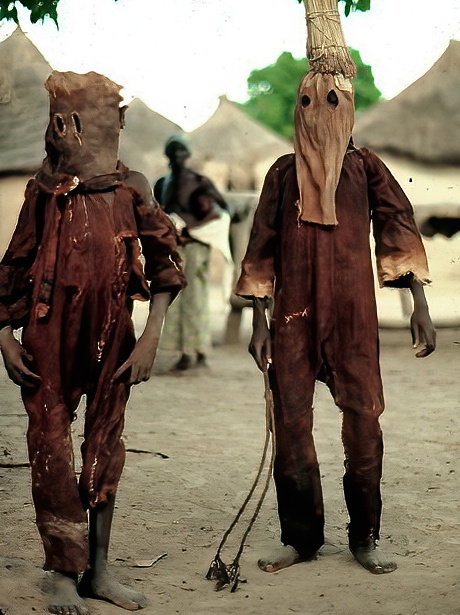
One is characterized by an oval face with four to ten horns in a row on top like a comb, often covered with cowries or dried red berries. The other type has a ridged nose, a protruding mouth, a superstructure of vertical horns, in the middle of which or in front of which is a standing figure or an animal. The ntomo masks with thin mouths underscore the virtue of silence and the importance of controlling one’s speech.
During their time in ntomo the boys learn to accept discipline. They do not yet have access to the secret knowledge related to korè and other initiation societies.
The korè society is perceived by the Bambara people as the “father of the rain and thunder.” Every seven years a new age-set of teenagers experiences a symbolic death and rebirth into the korè society through initiation rituals whose symbols relate to fire and masculinity. Initiations take place in the sacred wood, where the youths are harassed by elders and the clown-like performers called korédugaw. In their general form and detail, a group of korè masks conveys concepts such as knowledge, courage, and energy through the representation of hyenas, lions, monkeys, antelopes, and horses. In addition there are masks of the nama, which protect against sorcerers.
The komo is the custodian of tradition and is concerned with all aspects of community life -- agriculture, judicial processes, and passage rites. Its masks are of elongated animal form decorated with actual horns of antelope, quills of porcupine, bird skulls, and other objects. Their headdress, worn horizontally, consists of an animal, covered with mud, with open jaw; often horns and feathers are attached.
Masks of the kono, which enforces civic morality, are also elongated and encrusted with sacrificial material. The kono masks were also used in agricultural rituals, mostly to petition for a good harvest. They usually represent an animal head with long open snout and long ears standing in a V from the head, often covered with mud. In contrast to komo masks, which are covered with feathers, horns and teeth, those of the kono society are elegant and simple.
Komo society mask, used in the second of the successive initiations that include masked dancers and sacrifices presented at the society’s altars. The purpose of Komo initiation is to commence the spirit of knowledge; to reveal to the Bamana boys self-knowledge and the advancement of personal qualities. The Bamana refer to the masks as komo kun, meaning “head of the Komo,” however more specific and individual names are also given to differentiate their special abilities. Common characteristics found in the majority of Komo masks include bird feathers and quills, porcupine quills, antelope horns, and mouths shaped similarly to those of a hyena. The hyena jaws give emphasis to the animal’s power and force, seen as symbol of knowledge. The masked dancers wear the Komo masks on the top of their heads, instead of in front of the face, and express their power through exhaling columns of embers or phosphorescent material. Other supernatural rituals are also practiced during the initiation with the goal to nurture balance in the community.
The tji wara society members use a headdress representing, in the form of an antelope, the mythical being who taught men how to farm. The word tji means “work” and wara means “animal,” thus “working animal.” There are antelopes with vertical or horizontal direction of the horns. In the past the purpose of the tji wara association was to encourage cooperation among all members of the community to ensure a successful crop. In recent time, however, the Bambara concept of tji wara has become associated with the notion of good farmer, and the tji wara masqueraders are regarded as a farming beast. The Bambara sponsor farming contests where the tji wara masqueraders perform. Always performing together in a male and female pair, the coupling of the antelope masqueraders speaks of fertility and agricultural abundance.
According to one interpretation, the male antelope represents the sun and the female the earth. The antelope imagery of the carved headdress was inspired by a Bambara myth that recounts the story of a mythical beast (half antelope and half human) who introduced agriculture to the Bambara people. The dance performed by the masqueraders mimes the movements of the antelope.
Antelope headdress in the vertical style, found in eastern Bambara territory, have a pair of upright horns. The male antelopes are decorated with a mane consisting of rows of openwork zigzag patterns and gracefully curved horns, while the female antelope supports baby antelopes on their back and have straight horns. The dancers appeared holding two sticks in their hands, their leaps imitating the jumps of the antelopes. From the artistic point of view the tji wara are probably the finest examples of stylized African art, for with a delicate play of line the sensitive carvings display the natural beauty of the living antelope.
In traditional African societies, a childless marriage is a grave problem. Further, childlessness seems to be the wife’s problem to resolve. Women with fertility and childbearing problems in Bambara society affiliate with gwan, an association that is especially concerned with such problems. Women who avail themselves of its ministrations and who succeed in bearing children make extra sacrifices to gwan, dedicate their children to it, and name them after the sculptures associated with the association. Gwan sculptures occur in groups and are normally enshrined. An ensemble includes a mother-and-child figure, the father, and several other male and female figures. They are considered to be extremely beautiful. They illustrate ideals of physical beauty and ideals of character and action. The figures are brought out of the shrine to appear in annual public ceremonies. At such times, the figures are washed and oiled and then dressed in loincloths, head ties, and beads, all of which are contributed by the women of the village. The size of the statues may vary from 12 inches to 4 feet. The figures are usually with a dignified air. Some have the arms separated from the body, flat palms facing forward, the hands sometimes attached to the thighs. They may have crest-like hairdos with several braids falling on their breasts. In the same style, representations of musicians and of lance-carrying warriors are found. There are also carvings with Janus head. Ancestor figures of the Bambara clearly derive from the same artistic tradition, as do many of those of the Dogon. Rectangular intersection of flat planes is a stylistic feature common to Bambara and Dogon sculpture.
Most Bambara claim to be Muslims. But many people still follow their traditional beliefs in spiritual forces relating to ancestors. In addition to prayers and offerings at the individual and household levels, spirits of dead ancestors are honored with elaborated community-wide ceremonies (Toulmin, 1992).
The Bambara high god is conceived of as a grain from which three other divine "persons," and finally, the whole of creation, are born. Bambara theology and religion are complex. Deep religious speculations exist among the Bambara sages and are transmitted orally without codification.
The Bambara believe in one god, Bemba, or Ngala, who is the creator of all things and has, in a way, created himself as a quaternity. This quaternity consists of Bemba himself, Mousso Koroni Koundyé (or Nyale), Faro, and Ndomadyiri; the last three correspond to the four elements—air, fire, water, and earth. Before the creation Bemba was named Koni and was, in a sense, "thought" (miri ) dwelling in a void; he is also the "void" itself (lankolo ). Accordingly, he cannot be perceived by humans using their usual senses. His existence is manifested as a force: a whirlwind, thought, or vibration that contains the signs of all uncreated things.
Bemba realized the creation of the world in three stages, each corresponding to one of the three other divine beings. In the first stage, called dali folo ("creation of the beginning"), the naked earth is created. God is known as Pemba in this stage, and he manifests himself in the form of a grain, from which grows an acacia (Balanza ). This tree soon withers, falls to the ground, and decays.
Prior to their conquest by Tukolor Jihadists, Bambara burial practices involved hanging the body on a tree until it rotted and keeping the bones after that. Following the conquest, however, most of them converted to Islam and started burying the body. Instead of the body, they put a band of cotton on a tree to symbolize the immortality of the deceased person's tongue (words). Funeral rituals for chiefs and spiritual leaders are highly elaborated, often involving rifle shots, lamentations, offerings by relatives and friends, ritual cleaning and inhumation of the body, and final burial feasts. The souls of dead ancestors are believed to come alive in the body of masked dancers and this event is celebrated annually. Ancestors are regarded as “vital forces” in protecting the living and in making the land fertile (Paques, 1954:135).
For the funeral, the dead body has its head shaved and it has its outside whitewashed with a paste made of cowries and water. Seven days later, a feast is held in the persons honor. The clan mourns for forty days, at which time, the corpse is considered an ancestor.
The Bambara practice a wide variety of religious and cultural ceremonies. Ancestors are remembered and honored with prayers and sacrifices. Each year, villagers celebrate a community-wide festival involving sacrifices and rhythmic chants by masked dancers who symbolize the resurrection of dead ancestors. Villagers also organize rain rites with the help of ritual leaders. Periodically, they observe less elaborated celebrations in which men of each household join hands to collect refuse, burn it, ritually breathe in the fumes, and finally throw the ashes in the river. By doing so, the men hope to “accumulate forces” that would make them stronger (Paques, 1954:136). To this list of ceremonials, one can also add circumcision rites and the annual village-wide the ceremony organized by the village tón.
The Bambara attributed their success to the lessons learned from a half-human, half-animal deity called chi wara, "working wild animal." Chi wara (or tsi wara), with his hooves and his mother's pointed stick, tilled the soil and turned wild grasses into grain. But because the people wasted the grain, chi wara returned to the earth. The farmers then created art and dance to recall him and his powers over nature.
These headdresses feature the antelope, giving visual form to important religious beliefs about fertility and growth. They were worn in dances at the beginning of the rainy season (or when a fallow field was re-seeded) to assure a good harvest.
Dancers who wore these headdresses covered their bodies with long grasses and cloth. They went bent over using two canes, believing that if they stood upright, they would offend the deity. The dancers accompanied farmers to the fields, supervised the planting, and then returned to the village where they danced. The dance consisted of jumps, sudden leaps and turns reminiscent of the actions of the antelope.
Three different styles of chi wara headdresses have been associated with distinct geographic areas within Mali. The first is a vertical style in which the body and legs of the male antelope are small, but the mane, nuzzle and horns are elongated and elaborated. Its open work mane with a zigzag pattern is said to represent the course of the sun across the sky during the agricultural year.
The female antelope in contrast is depicted simply as carrying a young on its back. This vertical style is typically found in the eastern parts of Mali (Segou region). The second is a horizontal representation of the antelope, generally more accurately showing the proportions of the animal. These are found in the northwest (Bamako region). The third type, from the southwest (Bougouni region), is highly abstract, generally smaller and included forms primarily of the antelope, but also of the aardvark and the pangolin (scaly anteater).
Illness is traditionally associated with the powers of spiritual forces. The Bambara use a variety of chants, invocations, dances and musical instruments in healing the sick and in divining the causes of diseases. They also learn about the knowledge of making protective charms by joining religious societies. Through membership in secret cults, some men hope to learn how to make poisons, antidotes, and magical formulas.
Music is a privileged art among the Bambara. It is often used in religious ceremonies as well as in divinations and medicinal practice. Music is either sung or made by instruments of their own making.
The chief instrument is the drum, also called the tabale. It was reserved for kings and chiefs and created from metal, often copper. The drums themselves were pieces of art, each being delicately crafted and stylized. They would contain engravings in the frame of the drum. The drumstick used to play the drum would also be adorned with bells.
A second commonly used instrument was a guitar or ngoni. These guitars would have rectangular frames and eight strings. At the end of the handle there would be bells attached, just like on the drums, holding religious significance. Harps were often used in a variety of ceremonies including sacrifices, cathartic and medical rites, purifications, aprotropaic rites and solitary meditations.
As noted above, household members do not share the same decision-making powers. Instead, the negotiation power of each member depends on seniority, gender and marital status. This inequality occasionally fuels intra-household conflicts. The cohesion of households is also threatened by the increasing importance of market gardens and wage labor for generating personal income (Becker, 1996). Junior men and women often seek to earn more cash from these money-earning strategies instead of devoting most of their time to cultivating the foroba (household farm). Beyond the household-level, the Bambara have historically waged a series of wars of conquest. Prior to the fall of the region under French colonial occupation in 1890, ambitious village chiefs often mobilized age-sets as an army for plundering and slave raiding.
Sources: