

The Gisu people, or Bamasaba people of Elgon, alternately Bugisu, Gishu, Masaba, or Sokwia, are a tribe of the Masaba people of eastern Uganda, closely related to the Bukusu people of Kenya. Bamasaba live mainly in the Mbale District of Uganda on the slopes of Mount Elgon.
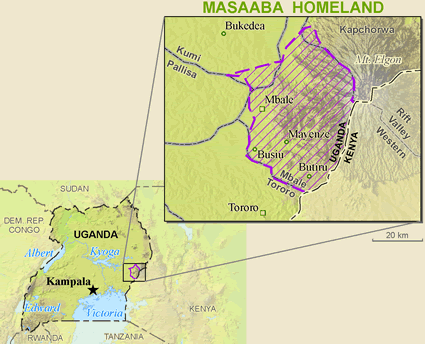
Generally, Bugisu stay on a mountainous region, a view evidenced by the presence of the towering Mount Elgon ranges a volcano located in Mbale District of Eastern Uganda. This area is well irrigated and contains some of the most fertile soils in the country, allowing the tribe to become dominant in agriculture.The highest point on these ranges goes as high as 8000ft while the low ones go as low as 4000ft above sea level (Khamalwa, 2004: 19). Interwoven with the hills, caves and gorges are rivers like Manafwa, Sorokho and Lwakhakaha, with countless tributaries where imbalu candidates perform the ritual of washing their penises before proceeding for pen surgery. In the areas neighbouring River Lwakhakha, imbalu candidates are taken very early in the morning to the river in order to make their muscles numb.
Gisu, Bageshu, Bagish, Geshu, Gishu, Masaba, Masaaba, Lugisu, Lumasaba, Sokwia.
There has been a steady increase in the Bagisu population throughout the twentieth century. Roscoe, writing in the early twentieth century, estimates a population of about 2,000 (Roscoe, 1924, 2). The census estimate in 1948 gives a figure of some 243,742 adult Bagisu men and women, of which 20,000 live outside Bugisu District particularly in the Uganda districts of Busoga, Buganda, and Teso, with small pockets of Bagisu living among the Sebei, chiefly in the Sipi and Bukwa areas (LaFontaine, 1959, 12). The census of 1980 records the population of Bugisu District as 529,202 excluding Mbale, the administrative town of the district (Heald, 1989, nt. 1, 43-44). In the 1991 census, the population of the district was recorded as 751,253 (SIL International, 2003). Population density varied with the fertility of the land under cultivation with the highest number of individuals per square mile in the mountain areas of Bugisu District. In the ten-year period between 1959 and 1969 population density rose from 329 per s quare mile to 441, with the highest density occurring in the more fertile mountain areas where it soared to 1,500 (Heald, 1989, 102). Based on these figures it is reasonable to assume that the Bagisu population has continued to increase into the twenty-first century.
Bagisu speak Lugisu, sometimes called Lumasaba which belongs to Niger-Congo language family. Like other Bantu languages, Lugisu has multiple dialects. While Ludadiri is a Lugisu dialect spoken by the Bagisu from the north, Lubuuya is the Lugisu dialect spoken in south Bugisu. Further, the Bagisu who live near the Babukusu of western Kenya have the influence of Lubukusu, the language of Babukusu. And yet, the Bagisu who live in Central Bugisu speak a Lugisu dialect influenced by languages including Luganda, Lusoga, Lusamia and Lunyoli.
Traditionally the Bagisu believe they are the descendants of Muntu (Mundu) the first man to live on Mount Elgon. He is said to have come out of a hole in the ground at the top of the mountain, but other traditions have him coming from Abyssinia (Ethiopia). The general belief of the Bagisu is that originally they lived at the top of Mount Elgon but as the population increased they moved down to the lower regions, although some say that it was the eruption of Mount Elgon, then an active volcano, that forced them to move. Based on similarities in language and culture, scholars suggest that the Bagisu may have once been part of the people inhabiting the Nyanza region of Kenya. It seems possible that they were first forced into the foothills of Mount Elgon by attacks of the Nandi. Two factors prevented them from expanding into the plains at this point: the continual raids by the Teso, and the fact that the land on the plains was less favorable for their type of agriculture. Expansion, therefore, was northward into the territory of the Sebei. Later, with the pacification of the area by Europeans, the Bagisu began to move down and settle on the plains (LaFontaine, 1959, 14).
Little was known of the inhabitants of Mount Elgon before the 1890s when the first European-Gisu contacts took place. Although Arab and Swahili trade routes passed within 30 miles of Gisu territory long before the late nineteenth century, no contact was made because of the fear of the ferocity of the Bagisu. In 1900, a party of Baganda, led by Semei Kakunguru, was sent under British authority to pacify the eastern province of Uganda, which includes the territory of the Bagisu. By 1905 Bagisu country finally came under effective British control, although sporadic fighting occasionally erupted against the Baganda who administered the area until 1910. In 1913 Bagisu chiefs were appointed as junior administrative agents replacing the Baganda, although senior administrators were still Baganda at least until 1934 when the last Baganda agent retired. Bugisu was officially declared a separate district in 1923, with its headquarters located at Bubulo and then subsequently moved to Mbale. Bugisu was united with Bukedi District in 1941, but retained its own District Native Court and Native Administration Treasury. In later years Pallissa and Bugwere were added to the district, which then was known as Mbale District and administered as such until 1954, when it was further divided into Bukedi and Bugisu Districts.
R. Tucker of the Church Missionary Society established the first mission station at Nabumali in Bugisu in 1899. A few years later the Catholic Mill Hill Mission opened a second mission. By the mid-twentieth century a number of other mission stations were established in Bugisu territory representing many of the main religious denominations. Each of these denominations had their own primary and secondary educational facilities (LaFontaine, 1959, 13-15).
In pre-colonial days, prior to 1900, the Bagisu preferred to build their homesteads high on the mountainside as natural defenses against marauding tribes. When settlements were built on the plains and lower foothills, however, it was necessary to construct walled and fortified villages to protect the inhabitants from the raids of neighboring tribal groups who were competing with the Bagisu for territory. At this time the settlements consisted of clusters of houses, forming villages, varying in size from 10 to as many as 100 houses. During the late twentieth century, with a vastly increased population, and no longer the need to congregate together for defensive purposes, Bagisu homesteads spread down the hillsides, into the valleys, and across the rugged countryside of the lower foothills and plains. These settlements are continuous and dispersed with no appreciable clustering of houses. Given the right to build on any portion of their own land that they wish, homesteads are frequently scattered among the plantations of plantains and between fallow and cultivated fields alike (Heald, 1989, 17).
The traditional style of dwelling consisted of a structure made of poles, saplings or bamboos interlaced into a framework, which was then plastered with mud and cow dung and thatched with grass or plantain fiber. The hut, which was arranged in a circle, had two doorways and was internally divided in two by a partition. One- half of the hut was occupied by the domestic animals, and one-half by the human inhabitants. By the mid-twentieth century separate kitchens and stock buildings are often constructed, and while the basic style of the house has been retained, huts now have steeper roofs, one doorway instead of two, and some even have windows. Other changes in house construction include rectangular shapes and a few brick and cement-plastered homes. Households typically consist of a man and his wife or wives and their unmarried children. Each elementary family within the homestead is spatially separated from one another with each wife having her own hut, kitchen, and own fields to cultivate. The separate huts of the wives were not necessarily in the same homestead, but scattered throughout the village, the husband visiting each in turn.
Circumcision in Africa is an old culture as practiced by the Bamasaaba in Eastern Uganda. The culture of circumcision was adopted by the Bamasaba from their in-laws the Maasai people. The men among the Bagisu tribe undergo initiation ceremonies known as Imbalu. The initiation ceremonies among the Bamasaaba are held every two years during August.
The Bamasaaba ancestors lived on bamboo shoots also known as malewa in the Lugisu language.These bamboo shoots are collected from bamboo trees on top of Mt. Elgon.

Maswahaba's first son with Nabarwa was Mwambu who was nicknamed Nkisu by his Maasai uncles who had stolen his fathers cows from him. Masawahaba failed to pronounce the nickname of Nkisu meaning a bull in Maasai language, given to his son his uncle and he pronounced it as Mugisu. The name Bagisu originated from the nickname Nkisu given to Mwambu by Maswababa's Maasai Brother-in-law.
The Gisu speak a dialect of the Lumasaba language called Lugisu, which is fully understandable by other dialects, and is also understood by the Bukusu.
Like many Bantu communities, the Bagisu are agriculturalists. Those who stay as far as 5000ft above sea-level grow Arabica coffee, the biggest portion of it being sold to Bugisu Co-operative Union (BCU) though other companies dealing in coffee also exist. On the other hand, cotton is grown in the lower plains extending as low as 4000ft above sea level. Tobacco is another cash crop grown by a small proportion of the population.
Much as bananas are grown primarily for food, the Bagisu also sell them to supplement the income earned from coffee, cotton and tobacco. In addition, the Bagisu grow maize, beans, millet, sorghum, yams and cassava. During unfavourable climatic conditions, the Bagisu acquire millet and other foodstuffs from the Itesots, Banyoli, Jopadhola, Bagwere and Sabinys which they use in the performance of imbalu circumcision rituals. The Bagisu also engage in business with their neighbours. Among the items traded in include food, sugar, salt, soap, cattle and musical instruments.
Food storage: The millet and corn, after drying, were placed into granaries—large wicker baskets with removable covers. The baskets were around five feet high and three feet in diameter. Villagers protected their crop from rain and insects by raising the stones off the ground with rocks or tree stumps and covering the outsides in cow manure.
The Bagisu hunted various wild animals for protein, usually small antelope.Hunting was primarily done with a spear, although nets were used on occasion. During warfare, men used spears and poison tipped arrows. Domestic animals were also kept, although they were rarely used for meat. Every household owned a few cows for dairy and several goats and sheep for trading. Families kept various types of fowl to be eaten on occasion, but they were not fed by the family and were subsequently not well nourished
Ceramics: Pottery was present among the Bagisu. Pots were baked out of clay (lidiri) from riverbeds between the new and full moons. Pregnant women are not allowed near pots while they were being made

There is a distinct division of labor between men and women in Bagisu society and between different age groups in each gender, although this division is not a rigid one. Certain tasks, however, if performed by the gender that does not normally undertake them, may cause ridicule to fall on the performer. In general, men's work includes planting plantains and such cash crops as coffee and cotton, tending and herding the cattle, cutting down trees and clearing heavy brush, house construction, hunting and trapping, butchering all livestock, cooking fowls (the flesh of which is taboo to women), and defending their property and families against outsiders. Traditionally women planted, weeded, and harvested the food crops, were responsible for the upkeep of the house and grounds, prepared the meals for the family, gathered certain vegetables used as relishes, gathered bamboo shoots at certain time of the year, took care of the children, made the clothes worn by married women, and fetched firewood and water. Both men and women made pottery, with men making the pots generally used in the long distance trade, while women made pots used in the domestic household.
Land is held individually by men under the strict guardianship of the minimal lineage that supervises the inheritance, loan, lease, pledge, or sale of the land to individuals outside the lineage. Subject to the authority of the minimal lineage a man may cultivate whatever crops he wants, dispose of them as he wishes including any assets that the land might provide, such as timber, clay, firewood, or iron ore. The landowner may not prohibit the use of his land when not under cultivation, for grazing, nor prevent other people from using the water supply of the land for themselves or their cattle, or closing a footpath to the area. The owner may sue for damage to his property but he cannot deny access to the resources of the land, which are deemed to belong to the community as a whole.
Women have only usufructory rights to land and neither inherit nor bequeath it. Throughout her lifetime she has the right to enough land to feed herself and children. She may also buy land for her sons, from the accumulated saving of cash and livestock given to her as presents by members of her lineage such as her brothers. Her husband or brother does the actual purchase transaction, but should she die before the sons are adults, the property reverts to her husband in trust for the sons.
The Bagisu conceive of their society as being composed of a series of progressively more inclusive patrilineal descent groups, ranging from the smallest lineage group (the minimal lineage) to the category of all the descendents of the founding ancestor Masaba (the clan). In LaFontaine's analysis of the descent system, he uses the term "tribal section", composed of between 9 to 11 generation, as being roughly equivalent to the district. Tribal sections are further subdivided into maximal lineages with distinct territorial bondaries. Roscoe refers to these units as clans (Roscoe, 1924, 2-3). The maximal lineages in turn are divided into major lineages and these into minor lineages. All three of the lineage orders are territorially based; the minor lineage is associated with the village, the major lineage with a cluster of villages, and as noted above, the maximal lineage with the district. In addition to the above the minor lineage segments into exogamous units known as minimal lineages. Members of this group d o not constitute compact residential blocks in the community since they live scattered throughout the village area.
Although theoretically Bagisu kinship terms are extended to all members of the maximal lineage, in actual practice they are used primarily within the minimal lineage in referring to a male ego's own, his mother's and his father's mother's minimal lineages. On occasion the kinship terms may also apply to relatives outside the circle of primary kin. A wider use of the terminology occurs when unrelated Bagisu meet outside the territorial area and use kinship terms to indicate common tribal origins. All members of ego's generation, male speaking, are called siblings. Cousins are classed with siblings, although sometimes a descriptive term is added to indicate the degree of relationship involved (e.g., YAIYA WE SENGE or sibling of father's sister). No distinction is made between cross and parallel cousins in terminology.
In the first ascending generation, a male ego calls his father and all the father's siblings of the same generation, BAPA (papa), his mother and all the mother's siblings of the same generation, MAYI.
MAYI is also the term used by ego to refer to his father's other wives. All men of the first ascending generation who are referred to as siblings by ego's mother are called MAMA or KHOTZA (mother's brother), while all women whom ego's father calls siblings, are called SENGE (father's sister).
In the second ascending generation no distinction in terminology is made between paternal and maternal grandparents. All males of this generation are called GUGA and all females KUKU. These terms are also applied to the spouses of the grandparent's generation. There is no terminological distinction made in the second descending generation, all are called UMWITZUKHULU (LaFontaine, 1959 , 29).
The Masaba, Bukusu and Luhya people believed that their ancestors were Kundu and Sela. The people of Ethiopia and the Ethiopian Highlands have no name for Kundu, except that it is a mountain peak in Oromiya.
The Bamasaba ancestor, Maswahaba migrated from the Ethiopian Mountains traveling via Lake Turkana to Sironko and settled around Bududa where he fell in love with a Maasai girl who was known as Nabarwa. The family of Nabarwa demanded that in order for Maswahaba to marry their daughter he had to undergo their rite of circumcision. He agreed to do so.
In theory, at least, Bagisu women are treated as jural minors throughout their lives, first under the authority of their fathers, and then under that of their husbands. In actual practice, however, the right given to men to manage their own affairs is also given to women (Heald, 1989, 95). Women, therefore, have the recognized right to choose their own spouse, and subsequently the right to initiate divorce.
Among the Bagisu, there are three ways to marry: (1) by formal alliance (BUXWALE); (2) by elopement (BUBELA); and (3) by widow inheritance (XURELA NAMELEXWA). Once the brideprice has been paid all three methods are equally valid, and all three give the husband rights to his wife's labor, control over her movements, and sexual rights.
The BUXWALE or formal alliance type of marriage is arranged by the fathers of the couple and validated only after payment of the brideprice. The elaborate ceremonies associated with this form of marriage function to indicate the importance of the alliance which the marriage creates, and to bring honor to the bride and dramatize her change in status from a daughter to a wife. During these ceremonies, the bride is forbidden food or drink (beer), and must prove her industry by performing tasks contrived by the groom's family. These traditional ceremonies changed somewhat in the 1960s, when they were combined with a church wedding, particularly among the wealthy and educated elite who tended to marry among themselves. For the poorer Bagisu families, this expensive and prestigious form of marriage had no practical value and was resorted to only in cases where two men wanted to cement friendships by the marriage of their children.
The majority of weddings among the Bagisu are either through elopement or widow inheritance, either of which involves a minimum of ceremony and expense. In the widow inheritance form of marriage, only a goat or two need to be given to a woman's father in recognition of the new marriage. Available widows, however, are subject to the "laws" of supply and demand, and sometimes they are objects of fierce competition among potential suitors. Marriage by elopement is fairly common among the Bagisu, and for young men in the society, is often seen as the only way in which a reluctant father is forced to provide a brideprice for his son, which is frequently negotiated after the elopement takes place to legitimize the union. Marriages of this type are often the result of clandestine love affairs with an unmarried girl of the area, or grow out of casual unions. Once the woman moves in with man she is referred to as his wife. Children conceived during this time belong to the father for biological paternity among the Bagi su is absolute and inalienable. Illegitimacy only occurs when the woman refuses to name the father, in which case the children become the responsibility of her brother.
At any time during her marriage a woman can return to her father without interference from her husband. If she does this and does not return to her husband, or if she is said to be barren, lazy, or adulterous, the husband can divorce her and the brideprice paid for her returned. If the woman has had several children by the husband, however, the father may keep one or more cows from the brideprice. In cases where her husband without justification drives a woman from their home, or if she leaves him because of his failure to fulfill his duties toward her, then no brideprice is returned. The woman may then obtain a divorce and be free to marry again. Divorce procedures in the latter case follow a traditional pattern of appeal to the lineage head and council of elders. The lineage head or presiding elder asks the woman three times if she will return to her husband. If the woman answers in the negative, the lineage head and elders will attempt to determine who is at fault in the marriage in order to decide the que stion of the return of the brideprice. On divorce a woman usually takes her youngest children with her while the older ones are given the choice of residence -- with father, mother, mother's brother or other relative. A husband can bring suit against his father-in-law if the latter receives his daughter back into his home without taking any action to inform the husband about the grievance against him or sending the woman back. Punishment of such an offense was traditionally the fine of a goat, but in recent times by a sum of money.
Polygyny exists among the Bagisu and is often an achievement goal among some men, while denounced by others for the trouble it causes, particularly in terms of quarreling between co-wives. Generally it is the wealthier men in the society who can hope to achieve stable polygynous unions since they can afford extra brideprice payments, provide a higher standard of living for his wives, and provide sufficient land for their use. Serial polygyny is far more common although even here the women have to face a certain degree of rivalry.
The basic domestic unit among the Bagisu is the conjugal family, consisting of a man, his wife or wives and their unmarried children. As sons reach adulthood they move away to set up their own households. In polygynous families, each wife has her own dwelling, kitchen, and fields. Other adults who are staying in the compound under the protection of the family head are considered as "attached" to the household rather than an integral part of it. These adults would include divorced or widowed mothers or sisters who are given their own huts and plots of land in order to maintain themselves separately from the rest of the family.
During a man's lifetime his land is equally divided among his wives. At his death the sons of each of his wives inherits an equal share of the property in proportion to the amount of land used by their mothers. If a woman has no sons the property of her hut is divided equally among the sons of his other wives. This property includes domestic animals, utensils, agricultural tools, and land. The widow of the deceased has life use of the land given to her during her husband's lifetime, and, unless she remarries will continue to cultivate some of these fields. Generally the widow will go to live with her youngest son, who after her death will inherit the fields cultivated by his mother during her widowhood. A man's daughters, however, does not inherit either land or livestock at her father's death. Should there be many animals, a brother may give her one, but this is considered a gift rather than any form of inheritance. Unlike other property, cattle are not divided among a man's wives, thus the sons do not inher it according to the shares of their mothers, but instead equally from the whole herd. These cattle may be divided among the sons or retained as one herd under the supervision of the eldest brother. Each son is entitled to take as many animals from the herd as he wishes to provide the brideprice for a wife. If some of the sons are very young when the father dies, land and livestock will be held in trust for them by the eldest son. The heir to the status and authority of the father is generally determined in a meeting at the end of the period of mourning. Often this position falls to the brother of the deceased, although on occasion the eldest son may be chosen for this role. The duties of this individual are to see that the widow and daughters are taken care of and that all the sons receive their proper share of the inheritance. He is also expected to take the dead man's place in the regulation of domestic affairs among his descendants and to act in their behalf in lineage affairs. The heir is also entitled to inherit the widow or widows of the deceased, but generally he only takes one. Differences vary between the Bagisu of the southern and northern districts in regard to widow inheritance. Among the southern Bagisu a son could inherit all the widows of his deceased father, except his biological mother, but this custom was not observed among the northern people. Should a widow refuse to be inherited in this manner, the heir must receive part of the woman's brideprice from her father, the amount varying depending on the age of the widow and the number of children she has borne.
At the death of a woman, all land and livestock given to her during her lifetime by members of her lineage are inherited equally by her sons. Among the Bagisu, women have only usufructory rights to property, but the sons who inherit from her have rights of possession. Land loaned to her must be returned to the lender. Personal ornaments go to a daughter, or lacking daughters, to a sister.
Before a man dies he may make a verbal will distributing his property following his death. This will is usually made known to his sister and some of the elders of the lineage. The dead man's wishes are usually respected in the distribution of his property, but unless he has disinherited one or more of his sons, the land must be equally divided among them. If this is not done, the lineage council may see fit to override the will.
As soon as possible after a child's birth it was given a name, a boy by its father and a girl by its mother. In either case the name was that of some deceased ancestor of the father whose ghost would then look after the child for the rest of its life. Should the child not thrive, a medicine man was consulted who sometimes advised the parents to change the child's name, since the ghost whose name it bore was causing the trouble. Weaning did not take place until the mother became pregnant again. There was no ceremony at weaning; the child was simply put under the care of a relative, in isolation from the mother.
During early childhood children learn gender related adult skills from their parents; boys from their fathers and girls from their mothers. At puberty the young adolescents undergo ceremonies of full admission to adulthood, relatively simple in the case of girls, and far more elaborate in the circumcision rituals for boys.
In Bagisu society, twins are considered lucky, but they are also considered ritually dangerous and are the subject of numerous ceremonies throughout their lifetime to protect their own lives and prevent their parents from becoming ill.
There is no clearly defined class structure among the Bagisu. Heald speaks of them as having an "incipient class division" (Heald, 1989, 260) pitting the landed against the landless, the haves against the have-nots, and the wealthy educated "elite", against the poor, uneducated, peasants. The distribution of wealth in the form of land and cattle is a major means of winning supporters and cementing alliances in order to achieve a position of influence in the society. A typical representative of this elite group, or as LaFontaine calls them, "notables" (BAKURU), is the lineage head (MUGASYA). This individual acts as an arbitrator in disputes and as a war leader. He is also empowered to act as a representative in matters dealing with the external relations of his lineage, such as in making peace pacts and defensive alliances. The notables by themselves have no institutionalized positions in the society as do the lineage heads, but nevertheless wields considerable informal power. It is from this group that the li neage head is chosen. The notables and the lineage heads tend to form an upper class from which political leaders are drawn. The equality of status enjoyed by both groups is further enhanced by marriage alliances that tend to form an intermarrying class system. The kinship links generated by the marriage alliances between different lineages add to the power of the notables to act as negotiators in the external affair of the lineage and also to their own specific importance to the lineage. The ties that this type of relationship creates between heads of lineages is used to generate alliances that often cut across the alignment of groups in the lineage system (LaFontaine, 1959, 31-32).
Roscoe, writing in the early twentieth century, claims that at one time the Bagisu had slaves that they bought from other tribes. These slaves were treated as members of the family. Female slaves were married into the tribe and males were adopted and allowed to inherit property (Roscoe, 1924, 7).
The smallest territorial unit in the traditional system was the neighborhood, a grouping which was not clearly defined and of little political significance. The neighborhood consisted of anywhere from six to 20 homesteads, the occupants of which had certain rights and duties to one another based on being neighbors rather than on any specific kinship ties. The sharing of food and beer, the loaning of domestic and agricultural implements, and mutual assistance in various tasks were all characteristic of this unit. In general the neighborhood constituted an essentially fluid grouping of people, and its member might, and sometimes did, move to other neighborhoods as the result of disputes.
The smallest political unit in the traditional system was the village consisting of several neighborhoods. The male inhabitants of the village were all members of a single patrilineal descent group or lineage who exercised the exclusive right to the ownership of land within the village boundaries. Each village had an institutionalized head called MUGASYA who was also the head of the lineage on which the village was based. The MUGASYA acted as a war leader, represented the village in matters affecting other villages, and also arbitrated disputes within the village itself. The village also served as a ritual unit containing a common shrine in which ancestral ceremonies were performed.
The village cluster, consisting of several villages, was the largest politically cohesive group among the Bagisu. Each village cluster formed a continuous tract of land extending anywhere from four to ten square miles, but with well-marked boundaries. The male population of these political units ranged from 600 to 1,000 inhabitants. Despite the cohesiveness of this group, it had no formalized leader; although the head of one of its constituent villages might achieve a position of influence within it comparable to that of the MUGASYA in his village. All male members of the village cluster, as with the individual villages, were considered as belonging to one lineage. Just as villages were grouped together to form village clusters, village clusters in turn were associated together into districts. These districts varied in size from six to twenty square miles, and might contain as many as 1,000 male members, which in theory at least, were all part of a maximal lineage. Inhabitants of a district shared certain spe ech and ritual characteristics, that distinguished them from other districts. The district was considered the largest unit within which it was considered possible to offer blood money for homicide. Generally there was little political unity or organized leadership within a district.
In the 1960s the lowest administrative unit is the parish varying in size from one to ten square miles, with a population of between 2,000 to 5,000 individuals. Within the parish area, the names of the former village divisions are still used for locational references. For convenience in tax collection the parish is subdivided into smaller units by the parish chief, each under the sphere of influence of a MUTALA, chief or headman, who acts as a personal and unpaid assistant to the chief of the parish. Each of these subdivisions has clearly defined boundaries, and bears the name of a lineage, sub-clan, or a feature of the natural environment. They commonly consist of between 50 to 100 male taxpayers from various lineages and sub-clans (Heald, 1989, 176).
The available literature on the Bagisu offers little information on institutionalized means of enforcing conformity to social norms. Traditionally informal sanctions, such as refusal to help in a project when requested, may have been sufficient to change recalcitrant behavior. Other means probably involved the pressure of public opinion, and the fear of witchcraft and having a curse placed on one's self.
Artistic expression among the Bagisu is primarily confined to singing, dancing, and the playing of musical instruments. The instruments include a seven-stringed lyre, played by professional males, a single or double-stringed musical bow played with a gourd resonator, a man's instrument, and a reed zither played by women. Drums are played by both men and women. On the plains area of Bagisu, a four-holed flute of bamboo is played with the instrument held vertically. Whistles of hard-bodied fruits are made by herd-boys. At one time side-blown horns were common, but these have generally dropped out of use in the twentieth century. Rhythm in music is sometimes provided by the beating of the open mouth of a jar with the hand in lieu of a drum. A twentieth century addition to the list of musical instruments is the imported guitar or the so-called "kaffir piano" Dancing is frequently accompanied by singing and instrumental music. The singer is usually a professional hired for the occasion. Leisure time activities, particularly for women and children, is the telling of traditional folk-tales and legends, whose themes deal with man-eating monsters, or moralistic tales involving common people.
In addition to magical curing practices, the Bagisu have a number of purely herbal cures, which are used to treat certain illnesses. An individual using these medicines, however, must have a special right to their use, for an unauthorized person is said to have no success in curing a patient.
The Bagisu also practice some surgery. They have enough knowledge of anatomy to recognize the function of the blood vessels in the body and how to tie them off in cases of excessive bleeding. Cupping is used to relieve rheumatic pains using the tip of a cow's horn, and the lancing of boils by "doctors" is common. Very skilled "doctors" would also open the chest of a patient to relieve pain. Apparently the Bagisu are not familiar with the technique of stitching wounds, but instead tie them with fiber bandages, and in the case of spear wounds pad them with extra fiber. Abdominal operations are not performed, although in the case of a woman dying in childbirth, the fetus is removed surgically before burial (LaFontaine, 1959, 56), wrapped in cloths and buried in a separate grave from the mother.
According to the Bagisu the "essence" of life resides in the shadow and death follows when this is removed by the creator spirit (WERE or NABENDE), through the agency of man or evil spirits. The soul of the deceased is not thought to go to any particular place, although some say that it exists for a time in the center pole of the hut or beside the door, returning periodically to that spot.
Traditionally the dead were not buried in the earth but exposed for wild animals to eat. It was believed that the soul of the deceased, if buried, would not be able to act as a guardian spirit for future children of the lineage and would cause them to die. Roscoe claims that the Bagisu ate the dead bodies (Roscoe, 1924, 40), but there is no evidence to prove or disprove this assertion. After the skeleton had been exposed, elders of the lineage took the skulls of circumcised men and women who had borne children and placed them in the lineage shrine.
In the twentieth century, burial is universal, and the traditional mortuary practices have largely disappeared. The description below generally follows the twentieth century pattern of burial.
As death approached and the man's shadow was thought to have left the body, the women break out into wailing. A member of the household is then sent out to notify the kin. If the dead man is of mature age and high status in the society drums will be beaten by specialist, women who are paid for their performance. The body is removed from the hut and placed on a bed or mat on the veranda of the structure with certain types of leaves on the chest to prevent the body from swelling. If the body swells despite these precautions, this is an indication to the Bagisu that the death was caused by witchcraft or sorcery. Depending on the gender and status of the deceased the body is left unburied for up to four days during which relatives and friends come to view the body and make small gifts to the family for funeral expenses. Dancing takes place for long periods of time at this wake, but there is no feasting, or drinking of beer.
After several days of dancing the burial takes place early in the afternoon. The corpse is wrapped in white cloth, purchased with the funeral gifts, and is sometimes placed in a coffin. For most people, graves are dug in the plantain gardens near the homestead by the close patrilineal kin of a man and by the patrikin of a woman. The exception to this is that an old man of high status is buried on the compound of his homestead. Favorite possessions are generally buried with the corpse or placed on the grave. About a month after the funeral beer is brewed and dispensed to all the individuals who danced and gave gifts at the funeral. The minimal lineage meets to choose the dead man's heir and to see that the deceased's property is fairly divided among the sons. At this time the cause of the death is discussed and accusations of witchcraft made. After the above events have been completed, the widow shaves her head and is either inherited by the ex-husband's brother, or returns to her parental home. Taboos of mourning are now lifted for all close kin of the deceased.
The Bagisu have a reputation for violence, a topic discussed to great length in Heald's monograph in this collection (see Heald, 1989, document no. 3). They are quick to anger and brawls are frequent in the society. Bagisu men are expected to stand up for their rights in everyday life and all grievances carry with them the threat of retaliation in some form such as killing, physical assault, theft, arson, crop destruction, and certain forms of witchcraft.
The Bagisu consider murder as a matter of interpersonal violence and retribution and wholly justified as a sanction in cases of adultery, theft, or witchcraft. In the 1960s the clearest pattern of Bagisu killing is based not so much on private retaliation, but justified in terms of the general good when the alleged perpetrator was convicted by the Bagisu justice system as a thief or witch.
The Bagisu reputation for violence follows them throughout East Africa; in Kenya, for example, they are proverbially thought of as cannibals, and in Uganda itself they are feared for their personal aggressiveness. The imputation of cannibalism attributed to these people comes from the earliest colonial writings on the area including reports and letters of missionaries and government officials. Roscoe, the missionary anthropologist, gives greater credence to this belief by reporting that the Bagisu ate their dead. This is strongly denied by the Bagisu themselves and there is no clear evidence to prove or disprove the theory that cannibalism ever existed.

The Bagisu worship a supreme God called wele lunya- also known as wele Namanga/Weri Kubumba. According to Naleera (2003: 10-12), namanga is derived from nanga, denoting a cloth, a view indicating that God wears a white cloth to symbolise his ‘holy’ nature. And yet, Khamalwa (2004) notes that wele wemungaki, the God who resides above, is the supreme God of the Bagisu whom the latter consider to be a porter, one who is able to do anything or the one who has power (2004: 22). Since wele is invisible and resides above, the Bagisu expect him to be everywhere and dwell in every activity they perform including imbalu circumcision rituals. Similarly, the Bagisu believe that everything which takes place comes from him thus respecting wele as much as they can. Wele-lunya has three assistance in performance of some of his duties.Three assistants to wele (called wele lunya) are as follows:wele maina, the one responsible for animal wealth (buhindifu) and is the one who removes barrenness from cows. To appease wele maina, a person sacrifices a barren cow to him in a special shrine. The priest (normally a diviner) brews beer, blesses it and then sprinkles it over the remaining cows to “remove” barreness from them. There is wele nabende who was responsible for rich crop yields and was in charge of banana plantations. The Bagisu sacrificed to him by deliberately leaving some bananas to ripen in the banana plantations. Further, wele nabulondela was responsible for births and was symbolised by millet put on the pillar of the house. While brewing beer, the Bagisu keep it under the pole which holds the house in order to allow this deity have her share (see also Turner 1969). When a woman is in labour, she gets hold on the pillar of the house and the Bagisu believe that wele nabulondela is there to help her. In addition, since millet is used to symbolise this deity, the Bagisu expect the house wife to be as productive as millet and produce as many children as possible. As imbalu (male circumcision) symbolises the second birth, when the boy is brought to the courtyard for circumcision, the mother runs to the house and gets hold on this pillar to symbolise the second birth of her son.
Another deity, wele namakanda was responsible for fertility and was symbolised by the frog. As such, when frogs enter peoples’ homes, they are not supposed to be pushed away since they are believed to bring blessings to the woman of the home to have as many children as possible. Among the Bagisu, people, especially children are forbidden from hitting frogs. It is believed that since frogs “bring” blessings to women to have as many children as possible, hitting them causes the breakage of the back of one’s mother. As such, the mother may not be able to have more children.
Wele is not only responsible for bringing blessings to the people but also inflicting punishments on wrong doers. To do this, the Bagisu believe that God uses small deities among whom is wele matsakha who resides in thickets and is responsible for punishing his victims with sudden illness and fevers. Another dangerous deity is wele lufutu who was responsible for draining blood from people especially pregnant women. Wele lufutu is believed to reside in the river and is symbolised by a rainbow. Whoever could see a rainbow was not supposed to go to the river lest wele lufuutu drains his or her blood.
While wele wanyanga was responsible for causing drought, wele murabula was responsible for breaking the legs of people and animals. Murabula could also cause peoples’ and animals’ eyes to swell and was also appeased around the pillar of the house. Wele kitsali was responsible for causing epidemics like diarrhoea,
typhoid, fever, cholera and plagues. A “real” Mugisu man is expected to know how to avoid and also appease these deities.
During the performance of imbalu and other Bagisu rituals, these deities (especially those which are not harmful) must be called upon to come and bless the candidates or persons. In fact, these gods are believed to have power which can make candidates bleed profusely if neglected. The Bagisu believe that next to the gods are the ancestors who also have power to bless or harm people. Indeed, ancestors are believed to be part of the candidate since the candidates’ name is that of his grandfather or uncle who has recently been part of the human race.
Missionaries introduced the Bagisu to Christianity in the late 1890s. These European immigrants established an “Anglican” system that improved roads and infrastructure, subsequently dividing the area into districts. The Bagisu have been fighting with their neighbors, the Sabei, but the Bagisu tribe is larger and more affluent due to coffee and cotton production.

During pregnancy, women did not have to follow food taboos while men must be especially careful to not fall while walking or climbing, as this was thought to cause a miscarriage. After the child was born, the placenta was carefully buried behind the house.
Beer was then poured where the child was born and two trees were planted in front of the house, called mbaga and mwima. For fifteen days after giving birth the wife remained in seclusion, after which she shaved the hair on her head and body and swept the floor of the house.
The gendering process among the Bagisu begins when the child is born and this process is dependent on the sex one acquires at birth. Like in many other African societies, females and males are the only recognized sexes among the Bagisu. In the case where the child is born with both sexes, it is deemed abnormal and society does everything possible to change its sex especially through an operation. When a male child is born, it is called umwana umusinde while a female one is called umukhana. Female children are called bakhana (plural of umukhana) because they are expected to marry and bring home wealth as soon as they become mature. And yet, males are called basinde (plural form of umusinde) because society expects them to grow and become the custodians of the fathers’ households when the latter grow old . Further, male children are likened to a tree known as lusoola.
As mentioned earlier, a female child among the Bagisu is called umwana umukhana. When it is born, the female is welcomed into society as someone who must bring wealth to the parents when she gets married. As such, she is socialised to become a “good” wife by being associated with activities like making mats, cooking and knitting. To become a “good” woman, girl children are expected to stay near their mothers or aunties and learn “good” eating habits, sitting postures, how to cook and all those behaviours expected of “good” women in society. In fact, a girl who does not behave well exposes her mother to abuses. The mother is looked at as someone who does not know how to nurture her daughters “properly” and possible suitors may not come to such a home when looking for marriage partners. To make girl children turn into “appropriate” women, the Bagisu also use proverbs such as “bukhwale butuufu intekhelo” (proper marriage is cooking) or “umukhasi umutuufu amanya inda yo museetsa” (a proper woman knows the husband’s stomach). These proverbs are intended to remind the girl that her office in marriage is in the kitchen. She is expected to “maintain” the husband’s stomach. To demonstrate that cooking is one of the principle tenets of marriage, girls who go for marriage among the Bagisu are said to have gone to “Bufumbo College”, literally meaning she has gone to cook. If a Mugisu man wants to chase away his wife, he begins to occupy the kitchen and cook his own food. A “man” to cook food is abominable, a view which suggests that his wife is worthless.

After a death, the body remained in the home until the relatives of the deceased arrived. At sunset, the body was deposited at the nearest “waste ground.” As night fell, horns were blown and the children were told “jackals were coming to eat the dead.”During the night, elderly women related to the deceased went back to the body and cut off pieces for mourning. Over the next three days, relatives mourned in the house and “ate the flesh of the dead.”
Girls: Girls around the ages of 10 or 12 began the process of scarring their faces. Girls would cut the skin on their foreheads and rub ash into the wounds, the product of such actions being ornate keloids. Women could not marry if they hadn’t gone through this process.
Boys: Circumcision seems to have been common practice in the Arabian peninsula in the 4th millennium BCE, while the earliest historical record of circumcision comes from Egypt, dating to about 2400–2300 BCE. Circumcision was done by the Ancient Egyptians possibly for hygienic reasons, but also was part of their obsession with purity. (Mbalu) Boys showing signs of puberty were circumcised in a public ceremony that occurred every two years. For two to four months prior to the operation, the boys traveled to villages around the clan to receive gifts and dance.
The ceremony occurred two to three days after the arrival of the new moon. At this time, an offering of a fowl was made at the shrine to Weri, the god said to have made the universe, on Mt. Elgon. The boys were then taken into the forest by the medicine man and the chief—there a goat was sacrificed and the boys covered themselves with the contents of its stomach. After the boys feasted on the goat, they returned to a village where they danced as a group. The boys were taken to the shrine of Weri, blessed, smeared with clay, and told to return to their individual villages for the circumcision.
After having returned to their village, the boys were confronted by an old man that had them each agree to their duties to his clan. Once they agreed, a medicine man removed the boys’ foreskin and all of the skin on their penises, aside from a strip underneath. After two months of healing, the boys were allowed to join the men in clan councils and marry if they chose to.
Before circumcision, an initiate is administered with a certain herb called ityanyi. Its purpose is to arouse interest in circumcision within the candidate. Often the ityanyi is tied round the initiate’s big toe or it is put in such a place where he might jump over it unawares. It is believed that if the candidate who has taken the ityanyi is delayed or hindered from being circumcised, he might end up circumcising himself as his mind is said to be so much stimulated towards circumcision that no other thing can distract him. Circumcision among the Bagisu occurs biannually during leap years.
Every male has to perform the ritual upon reaching puberty. Those who abscond are hunted down and forcefully and scornfully circumcised. Before the day of circumcision, the initiates are tuned up by having them walk and dance around the villages for three days. Their heads are sprinkled with cassava flour and painted with malwa-yeast paste. Their relatives dance with them and there is much drumming and singing.

Girls, especially the sisters of the initiates, enthusiastically take part in the processions. It is believed that once a boy is circumcised he becomes a true Mugisu and a mature person. An uncircumcised person is known as a musinde. The circumcision operation on each initiate is pretty fast. The circumciser and his assistant move around performing the ritual as appropriate. The assistant circumciser pulls the foreskin of the penis and the circumciser cuts it off. The circumciser goes further and cuts from the penis anotherlayer which is believed to develop into another top cover for the penis if it is not removed. The circumciser proceeds and cuts off a certain muscle on the lower part of the penis. These three cuttings end the circumcision ritual.
The initiate is made to sit down on a stool and he is then wrapped in a piece of cloth. After that he is taken to his father’s house and made to move around the house before entering it. For three days, the initiate is not allowed to eat with his hands. He is fed. They say that it is because he is not yet fully initiated into manhood. After three days, the circumciser is invited to perform the ritual of washing the initiate’s hands. It is after this ritual that the initiate can eat with his hands. On the same day, the initiate is declared a man. It is then that custom allows him to marry. During the ceremony the initiate is instructed on the duties and demands of manhood. He is informed in addition that agriculture is very important and advised to always behave like a man. It is believed that the healing of the cuts depends on how many goats have been slaughtered during the initiate’s circumcision.

A ritual is performed. All the new initiates in the locality have to attend. This ritual is called Iremba. It is an important occasion which all the village people and, these days, even government officials attend. During ritual proceedings, the initiate could pick any girl and have sexual intercourse with her. The girl was not supposed to refuse. It is believed that if she refused, she would never have children when she got married. This poses problems of Christian females if they are chosen. Previously, circumcision was done in specific enclosures and only the initiates and the circumciser were allowed in. The rest of the congregation would just wait and listen from outside the enclosure. Today, however, all people are allowed to watch the whole process. Firmness the and courageous endurance on the part of initiate is appreciated as a sign of bravery.
If twins are born: A medicine man offered a fowl to the gods. Three days later, the twins’ heads were shaved and their fingernails were trimmed for inspection. After they had been inspected by the medicine man, the families of the husband and wife feasted together.
If a man committed suicide: His house was broken down and burned. If a wife committed suicide the husband was blamed and he was stripped of his home and possessions.
Murder: If a man murdered someone outside of the clan he had to kill a goat and smear the contents of its stomach on his chest. Until he did this, the man was not allowed to eat food with his hands.
However, girls begin to mark their foreheads with keloids at the age of 10 or 12 as a sign of clan membership. As a Bagisu girl is not allowed to marry until she has marked her face, it is probably closely related to the menarche. : A woman could not marry if she hadn’t gone through the initiation rites at the age of 12.
Bride purchase (price), bride service, dowry:
The husband paid a marriage fee to the family of the bride; the father of the groom negotiated the price with the parents of the bride. Usually the fee was three of four cows (but up to ten could be asked for); this was occasionally supplemented with goats. However, the groom provided the family of the bride with other gifts, such as a spear and a hoe, out of custom.
Before the marriage can occur, the groom must pay the marriage fee. After the bride’s family receives the bridal fee, the bride and a number of female companions (as men could not safely cross into another clan’s territory) stayed the night in the groom’s village. The party returned to their village the next day with a gift of a sheep or a goat. After a feast in her village, the bride returned to the village of her future husband, staying the night in his house with a family member. The next day the family member left and the wife began working in her field. Aside from this tedious process, not formal ceremony or period of seclusion existed.
Imbalu circumcision rituals are a religious ritual performance. Like other religious performances, these rituals are associated with spirits and their performance follows strict procedures. In addition, imbalu circumcision rituals are administered under the unquestionable authority of ritual executors; they involve the evocation of the dead; convenating; and have symbolic meanings which are not known by all the participants.
The performance of imbalu circumcision rituals is associated with spirits (kimisambwa), which are believed to have come from the clan of Nabarwa, the wife of Masaba who is believed to have lured her husband into getting circumcised. According to Khamalwa (2004), since all the Bagisu are children of Masaba and Nabarwa, they need to be circumcised in order to avert the spirits of circumcision (kimisambwa kyembalu) from haunting them. It is believed that when the Bagisu had attempted to “abscond” from imbalu, these spirits attacked the male children of Fuuya, thus forcing the Bagisu to revive the circumcision rituals. It has become mandatory that all the Bagisu get circumcised lest spirits of imbalu would haunt them. To appease these spirits, imbalu candidates are taken to various places to offer sacrifices, Further, imbalu circumcision candidates are smeared with clay from the sacred swamp as a way of putting these candidates in “fellowship” with the spirit of imbalu (kumusambwa kwe mbalu). The swamp where the clay (litosi) is got is
sanctified with sacrifices in terms of slaughtered hens and goats in appreciation of the power of the spirits of imbalu. Furthermore, this spirit is evoked through songs and dances performed in imbalu circumcision rituals. In fact, imbalu candidates are told through song that they should be firm in the spirit of Masaba, the name
given to imbalu.
Imbalu circumcision rituals involve the evocation of the dead to come and “witness” as well as bless the candidate. Many informants told me that the Bagisu respect the dead members of their society to the extent that they are referred to as balamu (the “living”). Among the means through which the dead are respected include naming children after them and leaving some food in the cooking pot so that the ancestors may find something to “eat” when they visit at night. Another means of relating to ancestors as the “living” is “calling” them to be “present” during imbalu circumcision rituals. If these dead people (bakuka ni bakukhu)come on their own during the performance of these rituals, they are believed to cause severe harm to the candidate. So, they must be “invited” through sacrifices, music, and dance so as to make the candidate firm during pen-surgery.
Imbalu is a religious performance since it involves convenanting. It is believed that the blood which is shed as a result of the surgery of the penis is a confirmation to the ancestors that the boy is part and parcel of the society the ancestors left.

The preparatory stage is the first phase in the imbalu cycle, which begins in January till July of an even year, the year of imbalu. The rituals, musics and dances performed in the preparatory stage are intended to announce to the prospective imbalu candidates, their parents and relatives that the year for imbalu rituals has began. As such, those who are ready to graduate into manhood are expected to come forward and declare their candidature through singing and dancing. Further, during the preparatory stage, imbalu candidates visit distant relations for blessings and to solicit for money and materials that will be are used in the rituals, as well as gifts.
The imbalu preparatory stage also involves the reminding ritual (khushebusa imbalu). The primary aim of the reminding ritual is to inform imbalu stakeholders that the year for imbalu has come so as to give them ample time to search for costumes, food and animals which are used to feed people and offer sacrifices (interview, 2009). And yet, Philip Wamayosi, an elder charged with the role of keeping the reminding drum stressed that khushebusa reminds boys aged between sixteen and twenty- two years about paying the “cultural debt” (interview, January th, 2009). Imbalu as a form of identity must be performed by all the Bagisu. As such, imbalu is also considered a cultural debt, which is an activity every male Mugisu must fulfill in order to be considered a member of the society.
Khushebusa is a ritual that reminds prospective imbalu candidates, their parents, relatives and circumcisers that the year is for imbalu. This ritual is performed on 1st January, during the circumcision year and involves sounding a special drum known as ingoma ye khushebusa (the drum that reminds). Ingoma ye khushebusa is a medium size drum of about three feet in length. It has a double membrane though only one side of this drum is played. The top part of the reminding drum is larger than its bottom. In every clan, there is a special family called babashebusa (those who remind others) charged with the responsibility of keeping and performing the reminding drum. The custodians of this drum are always aware of the beginning of the circumcision year and the activities it brings with. As such, when this year begins, they play the reminding drum from either their compounds or the village playground to tell people to “wake up” and prepare for imbalu circumcision rituals. Apart from being sounded to remind people about imbalu rituals, the reminding drum is also sounded during last funeral rites, especially the burial of men who produced male children. In fact, men who are circumcised and have produced sons are highly respected among the Bagisu and are accorded “powerful” burial ceremonies when they die. Relating imbalu circumcision rituals to activities like funeral rites establishes that imbalu defines the whole life cycle of a Mugisu.
Usually, the beating of the reminding drum begins at 4:00 O’clock in the morning. This drum is sounded every after six hours until 4:00 O’clock in the evening. Phillip Wamayosi, an elder charged with the custodianship of the reminding drum informed me that sounding the reminding drum begins early in the morning so as to deliver the message to all people. He said that “there are people who may go on journeys. We aim at giving the message when all people are still at home. They go on their businesses when they have heard the message”. Moreover, at noon is when most people come from their gardens. Wamayosi explained that sounding the reminding drum at noon is aimed at informing people that whatever they may do, imbalu rituals are part and parcel of their programme. Finally, 4:00 O’clock in the evening is a time when most social activities like naming or last funeral rites are performed. And since imbalu is defined as a social activity, the reminding drum is sounded at 4:00 O’clock to inform participants to come out and show the clansmen and women their intentions for imbalu in that year.
The sounding of the reminding drum follows a pattern which depicts clan seniority. A number of informants told me that among the Bagisu, older brothers are the ones to lead younger ones in all aspects of life and this hierarchy must be articulated during the performance of imbalu circumcision rituals. As such, the most senior clan sounds its drum first. Hearing the drum rhythms, the next clan follows until the least senior clan joins. At 4:00 O’clock in the evening, when prospective imbalu candidates hear the reminding drum, they put on thigh bells, headgears and other dancing regalia and go around villages singing and dancing. Among the songs sang during khushebusa rituals is “Khukana Bushebe.”
The candidates then move to village playgrounds or along major roads with other people responding to the songs they sing. The music performed by boys during this period is intended to announce to elders that they are ready for the imbalu circumcision ritual this year. As a matter of fact, this music and dancing are a way of communicating one’s candidature. Indeed, it is after hearing the reminding drum that the prospective candidates come out to portray their candidature through singing and dancing.
Khushebusa ritual is also a “school” for imbalu candidates to learn how to sing and dance imbalu. And since these boys do not have experience aboutmanhood, circumcised men are the ones who lead them in songs and dances. These are men who are skilful in singing, dancing and other societal values. While men inform boys about the role of men in society, they also educate boys on how to relate with other men in society. Such men are known as banamyenya (singular, namyenya). In his study about imbalu rituals, Khamalwa defines namyenya as “a local poet and historian, adept at composing didactic songs, knowledgeable in the history of the tribe in general, knows the myths and genealogies of different clans, as well as the legends associated with the different heroes.”
Since he is hoped to impart societal values, including the traits expected of men among the Bagisu, namyenya is charged with the responsibility of leading imbalu circumcision candidates. Among other activities of the khushebusa ritual is the blowing of horns (long and short horns known as tsingombi and tsimbebe, respectively). Candidates from adjacent ridges blow horns and are answered by their counterparts across the ridge. However, because buffalos are no longer hunted and yet they are the ones where horns are fashioned, horns have drastically reduced from imbalu musical performances. Most informants told me that since imbalu is intended to “turn” boys into “tough”, “aggressive” and “strong” “men”, costumes and props used in these rituals must be made from fierce wild animals. As a matter of fact, the buffalo is considered by the Bagisu to be among the “toughest” and “fiercest” animals. After the khushebusa ritual, imbalu candidates gather and perform isonja dance.
Isonja is an imbalu dance performed to train candidates about dancing skills as well as enable them get acclimatized with the items they wear when performing imbalu rituals. This dance is staged in an open field, normally one preserved for special clan meetings. Isonja dance is performed between the months of January and March since this period is not characterized with a lot of agricultural work. This dance is performed in the evening when candidates, their song and dance instructors, as well as the spectators have finished the day’s work and therefore have time to participate in the dance.
In staging isonja dance, imbalu candidates from a particular clan come together and hire an instructor either from their own village or another place to lead them in songs and dancing skills. Instructors are hired due to their scarcity in many parts of Bugisu; a situation that increases their demand in society.
Prior to the emergence of the “monetary economy”, each imbalu candidate could pay the instructors of isonja dance in terms of eggs, local beer or by physically going to work for them in their gardens. Each imbalu candidate contributes between two and five hundred Ugandan shillings per day for the isonja instructor.
While going to the venue of performing isonja dance, music takes central place. Candidates run to the venue while singing songs they learnt during khushebusa. Candidates “lead” themselves as they move to the performance venues. When they lead themselves, candidates show that they are people who can stand on their own as “men”. When candidates arrive at the performance venue, they stand in a circle and are led by their instructor, nanyenya. Nanyenya “tutors” imbalu candidates on how to sing, dance and take care of their dancing items- thigh bells, headgears, beads as well as the strips of skin which hang on their backs.
Namyenya takes on the “mantle” of leading imbalu candidates in songs and dancing skills at the dancing venue to test whether these candidates are ready for imbalu or no. According to Makulo, what defines a man among the Bagisu is having “tough” muscles as well as being strong. As such, someone seeking manhood is expected to prove that he is tough through the dancing. Among the songs namyenya sings while instructing imbalu candidates during isonja dance is entitled Yolele Yolele.
In the first line of the song, namyenya reminds candidates that the year for imbalu has come. In response, candidates confirm what namyenya tells them by singing “sincerely it has come”. While the song leader changes the text, candidates keep on repeating the same text. This musical form relates to the authority of “men” among the Bagisu. Men have authority and as such, when they talk, their authority must be adhered to. According to Kanyanya, by reemphasising that “it has come, has come”, imbalu candidates reaffirm their obligation to undergo imbalu (interview, January 18th, 2009). Namyenya tells candidates to go and tell whoever is not circumcised, particularly those who had postponed imbalu that it has come. In fact, namyenya’s last line “tomorrow, it will come” re-echoes the fact that one can never dodge imbalu among the Bagisu.
One of the basic motifs in isonja dance is performed when candidates bend their backsand stamp the ground with their right feet. Then one spreads his arms and moves them from the body (trunk). As he dances, the candidate stamps the ground; each time turning to a different direction. As a matter of fact, isonja dance is primarily intended to enable imbalu candidates to acquire dancing skills and become “tough” in preparation for the pen-surgery ritual. Further, it enables candidates to get acclimatised to items like thigh bells, a cirlet of wood or ivory on the fore head, and the headgear, all used during different imbalu circumcision rituals.
Other items include wooden circular objects with holes curved in the middle of each object so that the candidate can put his hand in it till it fits at the elbow. All these items are heavy and therefore, need mature, muscular, and strong candidates to carry them. As such, isonja is meant to transform boys into people who are mascular and strong enough to match with the traits used to define men among the Bagisu.
Isonja is indeed a site for testing manhood. Throughout the performance of this dance, traits which the Bagisu associate with men like aggressiveness, strength and persistence are emphasised and imparted. According to Andrew Mukhwana, a “real” man must be strong because after imbalu rituals, he is expected to become independent. Moreover, a man’s wife and children depend on him for protection. Further, in case of any war, men are the ones called upon to defend the society (interview, January 4th, 2009). As such, for someone to be allowed to undergo imbalu circumcision rituals, he must prove that he is strong while performing isonja dance. Similarly, Heald argues that “[l]ike a warrior, the boy must conquer his fear by convincing himself that he has the strength to overcome an enemy” (1982: 17). To “perform” strength through isonja dance, imbalu candidates are expected to bend the upper parts of the body and stamp the ground heavily, with their right feet. As one stamps the ground, the arms must protrude outwards from the main body, forming a concave shape with them. This concave shape, which Andrew Mukhwana called “khureka tsingumbo” (“sharpening the arms”) is a posture of protection. Sam Waneroba, aged forty-eight, told me that even in daily life, a man who defends himself is one who builds a wall around his home (interview, 2nd March, 2009). According to Waneroba, such a man protects himself before disaster befalls him. Indeed, performers of isonja dance who do not keep their arms “sharpened” are elbowed out of the dancing circle. Depending on how one dances, he is either pronounced young or weak by spectators and may be asked by the clansmen to wait for the next season as he matures and grows strong (see also Khamalwa, 2004: 75).
After composing their songs, candidates practice them as they move and dance on road sides with the peers escorting them. Sometimes, imbalu candidates meet with kadodi drummers to establish how the songs they had learn from namyenya can be enforced by kadodi music. To establish this connection, candidates first sing their lines as the drummers create the accompanying rhythms. The searching for imbalu, as discussed in the following subsection is a stage which ushers candidates to the search for manhood.
Imbalu rituals require a lot of resources in terms of money, food and animals and yet only one’s parents may not be in position to provide everything. As such, the novice needs assistance from other relatives. There is also need to visit relatives and friends for blessings so as to perform imbalu circumcision rituals successfully. As such, after the performance of isonja dance, imbalu candidates visit distant relatives not only to seek for blessings and material help, but also to announce their intensions of becoming “men”. George Wekoye told me that since imbalu ushers someone into manhood, the prospective candidate is expected to be bold enough to inform others that he needs to become a “man”. According to Wekoye, the boy must announce "it” himself such so as to enable his clanmen know that he is “ripe” for manhood.
To search for imbaludenotes searching for the “spirit of the Bagisu” and likened it to the Kigisu proverb “khuwenza kumusambwa kweefe” (we search for our spirit). imbalu is “war” and therefore, the boy must mobilize his relations (near and far) to come and stand by his side (see also Heald, 1982). As such, during imbalu rituals, one’s relatives must be visited and told about his candidature. In most cases, the female relations are the ones visited since they moved from their clans and got married in distant places. And since they are now in “their” own clans, these female relations must be visited well in advance because during the period when smearing, brewing of beer, visiting cultural sites and the cutting rituals are performed, these relatives are also busy with imbalu rituals of their husbands’ relations. In fact, searching for imbalu explains the fact that imbalu rituals are collective as they involve relatives from near and far as well as ancestors.
As they visit these relatives, the boy and his escorts run while singing and dancing. During my childhood, I participated in the activities of searching for imbalu where the song “Masaba Akana Imbalu”.
The song leader (namyenya) announces to the public that Masaba is demanding for imbalu, which literally means manhood. However, he warns Masaba that imbalu is “tough”, very “painful” and it tantamounts to cutting off one’s legs. Namyenya leads the song, telling people how Masaba is demanding for manhood. Members of the escorting team just respond aee, as if asking, “is it?” As Khamalwa explains, [t]he novice carries a long stick whose bark has been peeled off. This stick [,] known as kumukheti [,] is what he waves in the air as he dances … (2004:77).
Apart from the boy leading songs, namyenya also play a significant role in leading songs during the period of searching imbalu. Namyenya is always close to the boy to ensure that he learns other songs which he will sing while going to cultural sites, the maternal clan among other rituals. Sometimes, the boy is escorted by his female relations including his sisters and paternal aunts. The Bagisu expect men to be at the forefront during all public performances unlike women who are expected to merely follow what men do. Imbalu is a space through which men consolidate their power and as such, roles of leading songs, smearing candidates, brewing beer and circumcising are assigned to men...
After the “search for manhood”, the next stage the “the pen-surgery”, the rituals that climax with the removal of the foreskin from the penis. Indeed, the pen-surgery is the most intense stage in the performance of imbalu rituals and includes the rituals of brewing, smearing, visiting cultural sites and the surgery of the penis. These rituals are performed during the month of August since this is the month of the first harvest when people usually have enough food to feed candidates, their escorts and ancestors through sacrifices. In addition, the August imbalu rituals are performed for candidates who are commonly known as banabyalo (those who do not attend school).
Before examining the rituals, musics and dances performed during the pen-surgery stage, it is important to note that the performance of imbalu among the Bagisu follows clan seniority. As such, senior clans circumcise their boys before junior ones, to open the imbalu rituals. To “open” imbalu rituals denotes the fact that boys from Bumutoto, the most senior clan are circumcised first. According to Naleera, though many Bagisu believe that Masaba is the man who introduced imbalu, there was a time when the Bagisu stopped to circumcise. Imbalu was “revived by a Mugisu called Fuuya, son of Mukhama of the Bamutoto clan of Bungokho County.”
Because Bamutoto are associated with the revival of imbalu, they are considered senior and therefore, are the first to circumcise their boys before any other Bagisu. In the beginning of August, the Bugisu Cultural Board, instituted by the Local Councils from Bugisu organises the inauguration of imbalu ceremonies for Bamutoto boys to be circumcised. All the Local Council V Chairpersons of Bududa, Manafwa, Sironko
and Mbale Districts as well as Members of Parliament from Bugisu sub- region and other political leaders attend imbalu inauguration rituals.
Another dance performed during imbalu inauguration rituals is tsinyimbaand was presented by candidates from Bubulo East. Tsinyimba is a word used to denote the hand bells candidates use to hit a metal tied around their wrists to create rhythm for dancing. Unlike isonja dancers who use the feet to stamp the ground, tsinyimba dancers use the upper part of the body to display the basic dance motifs. As they shake their shoulders and heads, candidates spread out their hands. They then shake their heads; moving them to the front and behind. Moving to the pace of nanyenya’s song, candidates finally kneel down while moving their
backs up and down (see also Makwa 2005: 69).
After witnessing the dances and musics, the invited guests, are led by Bamutoto elders to witness the circumcision of their children. Since Bamutoto boys “open” imbalu rituals, the courage they display during the operation is significant for all imbalu candidates throughout Bugisu. Many informants confirmed that it is considered bad luck for the umulala (the one who faces the knife first) to shout or fall down when is being circumcised. Other candidates may follow umulala’s example and yet a “real” man must be firm and endure the pain from the beginning to the end of the pen-surgery. To show cowardice during pen-surgery is a demonstration that the candidate will not withstand the challenges of manhood. As such, when Bamutoto boys display courage during pen-surgery, the Bagisu become confident that all imbalu candidates will be firm and eventually transform into the men society desires.
After the circumcision of Bamutoto boys, other clans circumcise their boys but following their order of seniority (see time table illustrated by Khamalwa 2004: 26). The performance of imbalu circumcision rituals in accordance of clan seniority demonstrates that there are gender differentiations between the various clans in Bugisu. By the fact that the Bamutoto revived imbalu, they consider themselves as “better” men than men from other clans of Bugisu. Further, in all other clans among the Bagisu, imbalu candidates are arranged according to the age of their fathers. If there are five boys, whose fathers are brothers, it is son of the eldest brother circumcised first. However, before the actual pen-surgery, the rituals of brewing, smearing and visiting cultural sites, as well as maternal clans are performed.
The brewing of beer, done three days before pen-surgery, ushers in the most elaborate rituals performed on imbalu candidates. This ritual is performed both at the home of the candidate’s father and the clan leader where the candidate will be circumcised. In any of the above venues, the candidate is escorted to the stream to fetch water in a pot, which he carries on bare head. There is symbolism in the water taken directly from the stream and that which people keep in their houses. According to Reuben Wamaniala, an elder charged with smearing candidates with yeast, stream water is preferred because it is running unlike the “static” water kept in one’s house. To usher some one into manhood is ensuring that life is a constant “flow”. To ensure this, the Bagisu collect “flowing” water and use it while performing imbalu circumcision rituals (interview, December 28th, 2009).
When the candidate reaches home, he pours the water in a pot containing roasted dough called tsimuma. The elder then adds more water and places the pot under the pillar of the house (inzeko) for maturation. According to Victor Turner (1969), it is under the pillar of the house that the deity mulabula resides.
Mulabula is connected with reproduction and when a woman is in labour, she gets hold on this pillar in order to give birth. It is believed among the Bagisu that the head of the house must always appease this deity by brewing beer under the place it dwells if his wife is to have normal births. And since imbalu is likened to second birth, murabula must be appeased if the boy is to successfully undergo imbalu rituals. Murabula is also evoked to be present so as to bless the boy.
Normally, the beer brewed at the home of the candidate’s father is for clansmen to drink after the operation ritual. On the contrary, the beer brewed at the clan leader’s home is what is known as busera bwe kumwendo (the beer for the gourd). In every clan, there is an elder chosen due to his kindness, firmness during his circumcision as well as reproductivity to be in charge of the gourd.
In the gourd, he puts the millet-brewed beer and it is this beer that is sprinkled using the mouth on candidates for evocation of ancestral spirits. Millet is highly considered in the performance of imbalu rituals because it symbolised reproduction. According to Wekoye, after being circumcised, the Bagisu expect the novices to produce as many children as the millet does (interview, January 29th, 2009). Like in other imbalu rituals, the brewing process is accompanied by music and dance. While going to the clan leader’s home, the candidate and his escorts sing songs depicting the boy’s resolve for the knife.
Khuakha kamamela literally means “smearing yeast”. It is a ritual where imbalu circumcision candidates are smeared with yeast, beginning on the evening of the day when candidates brew beer and is repeated every evening up to the day boys are circumcised. This ritual involves putting powdered yeast (kamamela ke buufu) into water and mixing it to form a paste. And then, an elder considered for his kindness, wealthy and “productivity” because he has children- especially males, is chosen to smear the candidate. As he performs his task, he calls upon ancestral spirits to come and bless the candidate. He also tells the candidate to be firm during circumcision as well as what society expects of him as a man. A number of informants explained to me that the significance of the ritual of smearing candidates with yeast is to remind the candidates about what society expects of “men”.
Further, the ritual of smearing candidates with yeast enhances the definition of “real” men as people who are united, social and respectable in society. The smearing ritual concretizes the Kigisu proverb that “kali atweela kaluma ligumba” (litrally translated as “the teeth which bites together are the ones which can eat the borne). The above proverb means that men among the Bagisu should be together, united and respect one another in order to fight common enemies. Otherwise how can one man resist an attack alone? As the yeast man gives the above admonitions, the candidate must stay still and listen. He should not shake his body or even twitch an eye as this is interpreted as a sign of fear. Other members of the congregation may supplement on what the yeast man says. After smearing the wet yeast, the yeast man, known as uwakha kamamela, takes powdered yeast and spreads it on the candidate and repeats what he has said before.
Before the candidate is smeared with yeast on the second day, he performs the ritual of shaving off the hair from his head, which is known as khubeka litsune. This ritual is performed by the paternal aunt (senje) chosen because of her good behaviour, kindness and production of children especially males. The Bagisu belief that one’s paternal aunt is more or less his or her father. As such, the paternal aunt is given the title of female-father (papa mukhasi) and freely calls the mother of her nephews or nieces as “my wife”. After all, the cows she brought home in form of bride price are the ones her brother used on his wife’s bride price. As imbalu is likened to second birth, even the senje can give birth to the boy by “shaving off his boyhood” and prepare him for manhood (Wamayosi, interview th January, 2009). Furthermore, Wekoye told me that imbalu is a social activity which attracts all relations from various corners. And each of these relations must participate in transforming the boy into manhood. As such, shaving is the occasion “dedicated” to the female- father to give “birth” to her nephew (interview, January 29th, 2009). This occasion also enables the boy to know the significance of his paternal female relations and give them due respect in future.
While cutting off the boy’s hair, the paternal aunt evokes ancestral spirits to come and bless him. She also emphasises the fact that the boy should be firm during pen-surgery, get married and produce children as “real” manhood is assessed in terms of the above features.
For example, female children take their paternal aunt as their elder sister and can discuss issues of sexuality with her. As a matter of fact, paternal aunts teach their nieces “bed matters” and how to conduct themselves in marriage (see also Tamale, 1999: 18). Likewise, boys can entrust their paternal aunts with secrets about their lovers. Wanyera told me that in the event that a male child is suspected to be impotent, it is his paternal aunt to “check” to ascertain whether the allegation is true or not (interview, January 18th, 2009). In fact, the paternal aunt can have sexual intercourse with her brother’s male children if she is to find out about their virility. Similarly, during imbalu rituals, the paternal aunt can persuade her nephew to say whether he is ready for imbalu or not. In other words, the boy may tell his paternal aunt his feelings about imbalu especially if he has some fear for the knife and the aunt can persuade him to withdraw from imbalu.
Like other imbalu rituals, the shaving ritual is punctuated with music and dance. Among the songs sangs sang when the boy’s hair is cut is entitled “Umusani womweene Ukana” (You Demanded for Manhood Yourself).
This song is sung by female relations as the paternal aunt shaves the boy’s hair. In the song, the boy is told to be strong during pen-surgery; after all he is the one who demanded for (imbalu) manhood. He is also told to be ready to take on the “mantle” of manhood. According to George Wekoye whose role is to sprinkle imbalu candidates with beer, by re-emphasising the concept of manhood, female relations tell the candidate to perform the roles expected of a man in society. Among the roles a Mugisu man is expected of is to get married, produce children, sustain the basic needs of a family and welcome other members of the clan to his home.
After the shaving ritual, imbalu candidates are again smeared with yeast and taken around the major roads to sing and dance their way to manhood. They meet candidates from other clans, sing songs which depict their resolve for imbaluas well as confirm their readiness to fulfill the obligations of men in society. Imbalu candidates from various clans met together and re-affirmed their resolve for the knife. Among the candidates I witnessed was one Wakooba who sang about his ancestry and how he had been “crying” for manhood and his song.
Sources: