

The Kuyu (Kouyous) are a subgroup of the Mbochi people of eastern Gabon, central Republic of Congo, and western D.R.Congo.
Their contemporary population exceeds 40,000 people.
The Kuyu are an ethnic group who live in northern Congo-Brazzaville, on the banks of the River Congo, in a part of Equatorial Africa that has remained only marginally influenced by Moslem encroachment and Western colonialism. Although at first the predominant group in the area, they later became a minority within the broader Mbochi population.
They are especially concentrated in the Congolese Basin of northern Congo, a región criss-crossed by countless rivers.
They spend time in the dense forests as well as the steppes in the area.
Although they are increasingly turning to commercial agriculture, the Kuyu economy has traditionally revolved around trading and fishing, at which they are highly adept.
Their social structure is based on a patrilineal clan structure. The Kuyus have played significant roles in Congolese politics in recent years, because of the control they exercise in the armed forces of the country.
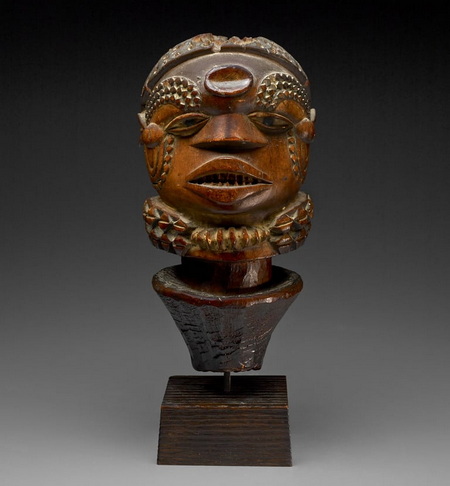
"The Kuyu people are divided into two clans whose totemic animals are the snake and the panther. They achieve cohesion through a secret male society caked Ottote. Kuyu artists carved light wood figures, known as Okue, who carry an emblematic animal on their heads. Very little is known about their function, but they are thought to be used during Ottote ceremonies. Kuyu carvers also produced wooden heads with rounded features and complex or conical coiffures. These heads were inset with feathers and carried on top of long poles during ceremonies at the end of the Ottote initiation period.” (Baquart, Jean-Baptiste. The Tribal Arts of Africa. New York: Thames and Hudson Inc. 1998. Print)
The objects making up their material culture have long remained unknown as they did not suit Western aesthetic tastes.
Kuyu art can be broadly broken down into three styles, the first two—of which there are the fewest examples—are strictly associated with the Kuyu ethnic group, while the third style, which has the largest sculptural component, includes both Kuyu and Mbochi pieces. Among these are a number of statuettes and especially wooden clubs topped with a human head (the most recent being polychrome), known as Kebe-Kebe, which were used in the dance by the same name. This ritual performance has remained faithful to its original function of giving physical expression to the Kuyu cosmogony.
The distinctive feature of these clubs is their attention to detail in their portrayal of particular faces, depicting a large variety of hairstyles, carefully rendering the teeth and accurately delineating scarifications, where present. The polychromy that distinguishes the third style of objects is also associated with a specific symbolic meaning.

Sources: